
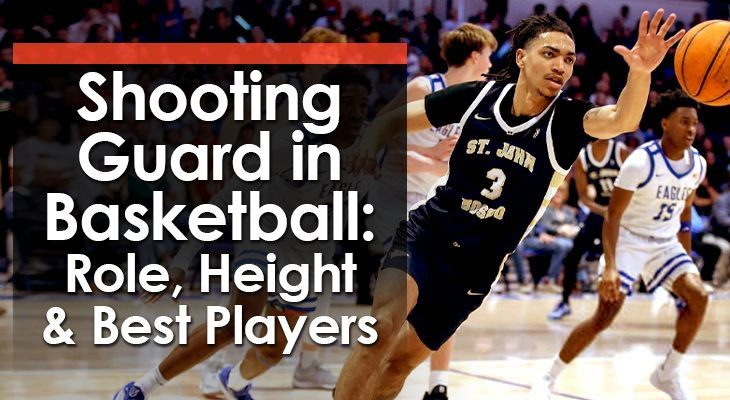
The shooting guard - also called the "2" or the "off guard" - is one of the five positions in basketball.
They're usually the team's best perimeter shooter, and their main job is putting the ball in the basket: knocking down threes, pulling up from mid-range, and attacking the rim.
For decades, that meant a mid-range scorer in the mold of Jordan and Kobe. The modern game has pulled the position out beyond the three-point line... but we'll get to that later in this guide.
What is a Shooting Guard in Basketball?
The shooting guard is the "2" in a team's lineup of five basketball positions.
Positions are numbered 1 through 5: the point guard is the 1, the shooting guard is the 2, the small forward is the 3, the power forward is the 4, and the center is the 5.
The "off guard" nickname tells you a lot about the role:
While the point guard runs the offense with the ball in their hands, the shooting guard usually plays OFF the ball... working to get open, catching, and shooting.
A great shooting guard gives the team reliable scoring from the perimeter, defends the opponent's best guard or wing, and steps in as the backup ball handler whenever the point guard needs help.
The 8 Best Shooting Guards of All Time
The fastest way to understand a position is to study the players who mastered it.
Here are eight shooting guards every coach and player should watch:
1. Michael Jordan – The greatest shooting guard of all time, and for most people, the greatest player. Six championships, five MVP awards, and ten scoring titles with the Bulls set the standard every 2 since has been measured against.
2. Kobe Bryant – The closest thing to Jordan the game has produced. Five championships with the Lakers, an 81-point game, and two decades of footwork that every young shooting guard should study frame by frame.
3. Dwyane Wade – The engine of Miami's 2006 championship run and the best shot-blocking guard the NBA has seen. Wade won three titles by attacking the rim relentlessly rather than relying on the three-point shot.
4. Jerry West – "The Logo." West averaged 27 points per game for his career and remains the only player to win Finals MVP in a losing effort (1969).
5. Clyde Drexler – "The Glide" filled the stat sheet with points, rebounds, and assists while playing above the rim. He captured his championship alongside Hakeem Olajuwon in Houston in 1995.
6. Ray Allen – The smoothest jump shot the position has seen. Allen retired as the NBA's all-time leader in made three-pointers and hit one of the most famous shots in Finals history in 2013.
7. James Harden – The most unstoppable one-on-one scorer of his era. An MVP award and three straight scoring titles in Houston, built almost entirely on the step-back three and the drawn foul.
8. Diana Taurasi – The WNBA's all-time leading scorer and a three-time champion with the Phoenix Mercury. Kobe Bryant nicknamed her the "White Mamba"... there's no higher praise from a fellow 2.
Look at how the position changes as you move down that list:
West and Jordan lived in the mid-range. Allen and Harden built careers behind the arc.
That's the story of the shooting guard over the last 40 years, and we'll cover it properly in the types section below.
(Wondering about today's game? Anthony Edwards, Devin Booker, and Donovan Mitchell are carrying the position right now.)
What Does a Shooting Guard Do?
The shooting guard's job description starts with the name:
Put the ball in the basket.
But the great ones contribute at both ends of the floor.
Here are the eight key responsibilities:
On Offense:
1. Score at All Three Levels – A complete shooting guard can knock down the three, pull up from mid-range, and finish at the rim. They're also the player the coach turns to for isolation scoring when the shot clock is running down and the team needs a bucket.
2. Space the Floor – A feared shooter changes the game without touching the ball. When the defense refuses to leave the shooting guard open, driving lanes appear for everyone else on the court.
3. Move Without the Ball – The point guard does most of the dribbling, so the shooting guard earns their shots with cuts, screens, and constant movement. The best ones never stand still.
4. Be the Backup Ball Handler – When the defense pressures or traps the point guard, the shooting guard must be able to bring the ball up and start the offense without it turning into chaos.
5. Run the Floor in Transition – A shooting guard who sprints the wing on every possession picks up several easy baskets a game before the defense is set.
On Defense:
6. Guard the Opponent's Best Perimeter Scorer – The 2 usually draws the toughest perimeter assignment on the other team. If they can't take that matchup, someone else has to give up their own assignment to cover for them.
7. Chase Shooters Through Screens – Guarding a moving shooter means fighting over and around screens for four quarters. It's exhausting, and it's non-negotiable.
8. Turn Defense into Offense – Active hands in the passing lanes create steals, and steals create fast break opportunities the other way.

5 Traits of a Great Shooting Guard
Plenty of players can shoot.
Far fewer have the full package the position demands:
1. Shooting Ability – The non-negotiable. A shooting guard who can't shoot forces the coach to play four-on-five offensively. Everything else on this list is built on top of a reliable jump shot.
2. Off-Ball Instincts – Great shooting guards read the defense while the ball is somewhere else... recognizing when to cut backdoor, when to sprint off a screen, and when to relocate along the arc. This is basketball IQ applied to movement.
3. Confidence and a Short Memory – Every shooter has bad nights. The great ones genuinely believe the next shot is going in, no matter what the last five did. A shooting guard who hesitates is a shooting guard the defense no longer fears.
4. Conditioning – No player covers more ground on offense than a shooting guard working off screens, and no defensive job is more tiring than chasing one. The position rewards players who are still sprinting in the fourth quarter.
5. Two-Way Toughness – Scoring is the fun half of the job. A great 2 also takes pride in guarding the other team's best perimeter player every single night, even when their own shot isn't falling.
Types of Shooting Guards (And How the Position Has Changed)
Not every shooting guard plays the role the same way.
Here are the four types you'll see in the modern game:
The Combo Guard
A player who splits the difference between point guard and shooting guard. They can run the offense when needed, but they're a scorer first. Many modern backcourts play two combo guards instead of a traditional 1 and 2.
The 3-and-D Guard
The role-player version of the position. Their job is simple: knock down open threes on offense and lock up the opponent's best perimeter player on defense. Every championship team seems to have at least one.
The Movement Shooter
A shooter in perpetual motion, sprinting off screens and firing the moment the ball touches their hands. Ray Allen defined the archetype, and Klay Thompson perfected it.
The Swingman
A bigger guard who slides between the 2 and the 3. Their size lets the coach hunt matchups: too big for opposing guards, too quick for opposing forwards.
How the position evolved:
When the NBA introduced the three-point line in 1979-80, shooting guards mostly ignored it. For the next two decades, the position belonged to mid-range scorers like Jordan and Kobe.
Then the analytics era arrived, and the math was brutal:
A three-pointer is worth 50% more than a long two. Teams stopped taking mid-range shots, and the shooting guard's office moved beyond the arc.
Today's 2 shoots more threes than any generation before them, and the best offenses in basketball are built on their gravity. It's part of the broader shift toward positionless basketball, where shooting is a requirement for everyone, not a specialty for one position.
How Tall is the Average Shooting Guard?
At the NBA level, most shooting guards stand between 6'4" and 6'6".
In the WNBA, most shooting guards are between 5'10" and 6'1".
At the youth level, forget those numbers.
The shooting guard is typically the second-shortest player on the floor (only the point guard is smaller), but height matters less at the 2 than at almost any other position.
If a player can shoot, move without the ball, and defend, they can play shooting guard at nearly any size.
How to Play Shooting Guard (7 Tips)
For players who want to earn the 2 spot and keep it, here's where to focus:
1. Master Your Shooting Mechanics – Everything starts here. A fundamentally sound shot improves for years, while a flawed one hits a ceiling fast. Work through the full 10-step shooting guide until the mechanics are automatic.
2. Earn "Knock-Down Shooter" Status – The goal isn't making shots at practice. It's becoming the player the coach trusts to make them in games, which takes thousands of repetitions of game-speed shooting drills — catch-and-shoot, off the dribble, and off movement.
3. Learn to Score Without Dribbling – When Klay Thompson scored 60 points against the Pacers, he dribbled the ball JUST 11 TIMES. Study how elite shooting guards use cuts and screens to get open before the ball ever arrives.
4. Master the Backdoor Cut – Once you're a feared shooter, defenders will overplay you to deny the catch. Set your defender up like you're coming to the ball, then plant your outside foot and explode to the rim for the layup.
5. Develop a Go-To Finish – Getting to the rim is only half the job. Build a reliable floater for shooting over help defenders, and add a reverse layup for when the angle disappears.
6. Own the Free-Throw Line – A shooting guard should make at least 80% of their free throws. Shoot them in sets of two between drills at every workout... it's the closest you can get to game conditions when training alone.
7. Sprint the Floor Every Possession – Beat your defender down the court and you'll get several layups a game without running a single play. Even when the pass doesn't come, you'll arrive in perfect position to start the offense.
Shooting Guard FAQ
What is the difference between a shooting guard and a point guard?
Ball responsibility. The point guard is the primary ball handler and decision-maker who brings the ball up and runs the offense. The shooting guard plays off the ball as the team's main perimeter scorer, earning shots through movement rather than the dribble — though the modern game blurs the two roles more than ever.
What is the difference between a shooting guard and a small forward?
Size and playing style. The shooting guard is usually smaller and more perimeter-oriented, doing most of their scoring off the catch and off screens. The small forward is bigger and more versatile, attacking the rim and rebounding while still playing on the wing — though modern wings often cover both roles.
Is Steph Curry a point guard or a shooting guard?
Steph Curry is a point guard. He brings the ball up and initiates the offense, but he plays off the ball more than any point guard in history — sprinting off screens like a classic movement shooter, which is why the question gets asked so often. His shooting form is worth studying no matter what position you play.
What number is the shooting guard?
The shooting guard is the 2. Basketball positions are numbered 1 through 5: point guard (1), shooting guard (2), small forward (3), power forward (4), and center (5).
Who is the best shooting guard in the NBA right now?
Anthony Edwards is the most common answer, with Devin Booker and Donovan Mitchell right behind him. All three carry the position's classic profile: elite scoring from all three levels with the confidence to take the biggest shot of the game.

Conclusion
The shooting guard is the position built around the skill everyone notices first: putting the ball in the basket.
But the great ones offer far more than a jump shot.
They space the floor, move relentlessly without the ball, guard the toughest perimeter matchup, and stay ready to fire even after three straight misses.
Build the shot first. Then build everything around it... that's how a shooting guard becomes the player the whole offense leans on.