
A basketball practice plan breaks your practice into timed sections so every minute on the court has a purpose.
Every practice plan on this page is built on the same formula:
50% skill development, 25% team strategy, 25% small-sided games.
You'll find a complete 90-minute plan below, plus full practice plans for kindergarten through high school and also a printable template.
The 90-Minute Basketball Practice Plan
Here's the structure I recommend for a standard 90-minute practice:
1. Dynamic Warm-Up (0:00 – 0:10) – Jogging, sliding, skipping, lunging, and dynamic stretching to prepare the body for high-intensity work.
2. Skill Work (0:10 – 0:55) – Dribbling, passing, shooting, finishing, and individual defense. This is the biggest block of practice by far.
3. Team Strategy (0:55 – 1:10) – Your offense, your defense, or set plays.
4. Scrimmage / Small-Sided Games (1:10 – 1:25) – Competitive games that force players to use their skills against live defense.
5. Cool Down (1:25 – 1:30) – Light jogging and static stretching while you talk to the team.
Add drink breaks in 3 – 5 minute blocks wherever your team needs them, taking small chunks from the sections around them.
If your practice is shorter or longer, the structure stays the same.
60-Minute Practice:
Dynamic Warm-Up – 10 minutes
Skill Work – 25 minutes
Team Strategy – 10 minutes
Scrimmage / Small-Sided Games – 10 minutes
Cool Down – 5 minutes
120-Minute Practice:
Dynamic Warm-Up – 10 minutes
Skill Work – 60 minutes
Team Strategy – 20 minutes
Scrimmage / Small-Sided Games – 25 minutes
Cool Down – 5 minutes
How to Structure a Basketball Practice
Every practice plan I create follows the same formula:
50% skill development. 25% team strategy. 25% small-sided games.
I call it the 50/25/25 formula... and it works for any team at any level.
Five sections appear on every plan, but the warm-up and cool down are bookends. The formula describes how the court time between them splits.
Half of practice goes to making individual players better. A quarter goes to how your team plays together. And a quarter goes to competing.
One thing you'll notice in the plans below: skill work often runs over half, and strategy under a quarter. That's deliberate. The 25% for strategy is a ceiling, not a target... and every minute it doesn't use goes back to skill development.
Here's each of the five sections in more detail:
1. Dynamic Warm-Up
This section of practice cannot be skipped.
Most youth teams perform a 2-minute warm-up before moving immediately on to other sections of practice.
When I watch youth basketball games, it becomes quickly apparent that the best players have fantastic balance, coordination, change of speed, and change of direction. The players who struggle haven't learned how to control their bodies yet.
It's extremely important to help players establish an athletic foundation. With this foundation in place, it becomes much easier to learn new basketball skills as they progress.
A good dynamic warm-up will also help prevent injuries. And it helps players in all sports and movements of life, because as we all know, players shouldn't be specializing solely in basketball at a young age.
Movements to include:
Jogging, sprinting, backpedaling, sliding, change of direction, change of pace, jumping, landing, lunging, and skipping.
For a full breakdown of warm-up movements, see basketball warm-ups.
2. Skill Work
The bulk of every basketball practice should be skill work.
This is the 50% of the formula, and it includes drills that teach players how to perform a skill correctly, along with drills that teach them when to use it.
Drills that allow players to learn when to use the skill are often skipped over.
Referring to shooting, this is a great quote by Jeff Van Gundy:
"Shooting percentage is just as much about decision making as it is about technique" – Jeff Van Gundy
This rule goes for all skills, not just shooting.
A lot of coaches will show players exactly what they need to do... they'll give fantastic instructions, and the players will eventually look brilliant at training. Then the players get into a game and it looks like they've forgotten everything!
Why does this happen?
Because they haven't learned to use their skills against competition.
Use technique drills as a short primer, then spend the bulk of the time on game-like drills.
Dribbling Example: 5 minutes of stationary ball handling and then a game of 1v1 in the full court.
Shooting Example: 5 minutes of shooting form and then 1-on-1 partner close-outs with the offensive player deciding whether to shoot the ball or drive.
Passing Example: 5 minutes of form passing and then a 10-minute game of 5 vs 4 keep-away.
BFC TIP: At the youth level, drills should be no more than 10 minutes long. The players will start to become disinterested after that time. Keep them short and fun!
3. Team Strategy
Team strategy is the least important component of a youth basketball practice.
And in my opinion, it's not necessary for players under the age of 10.
The team strategies section of training includes offense, defense, set plays, and special situations.
If you decide to use this section of practice with your team, dedicate only a small amount of time to it.
Too many coaches steal practice time from skill development and spend half of practice helping athletes memorize set plays.
4. Scrimmages / Small-Sided Games
The final 25% is where players compete.
What's the point in your players learning how to do a crossover with great technique if they don't understand when to use it in a game?
This doesn't mean letting them loose in a 5-on-5 game every practice. Most of the game-play in a youth practice should be "small-sided."
Small-sided games (SSGs) have fewer participants on each team than a normal game (1v1, 2v1, 3v3, etc.), and the benefits are huge: more touches, more space to practice moves, and more opportunities to score points.
One warning before you start:
Game-like drills look messy... and that's the point.
Players will turn the ball over, spacing will break down, and help defense will disappear. Games are messy and chaotic, so practices need to be messy and chaotic too. If every drill you run is scripted and looks clean, your players aren't being prepared for real game conditions.
5. Cool Down
The cool down should consist of a couple of minutes of slow jogging and walking up and down the court, then a few minutes of static stretching.
The stretching part of the cool down is a great time to talk to the players. We might talk about an upcoming game or how we felt practice went.
Basketball Practice Plans by Age
Below are four complete practice plans, one for each age level.
The structure stays the same at every age. What changes is the length of practice, the complexity of the drills, and how much team strategy to include.
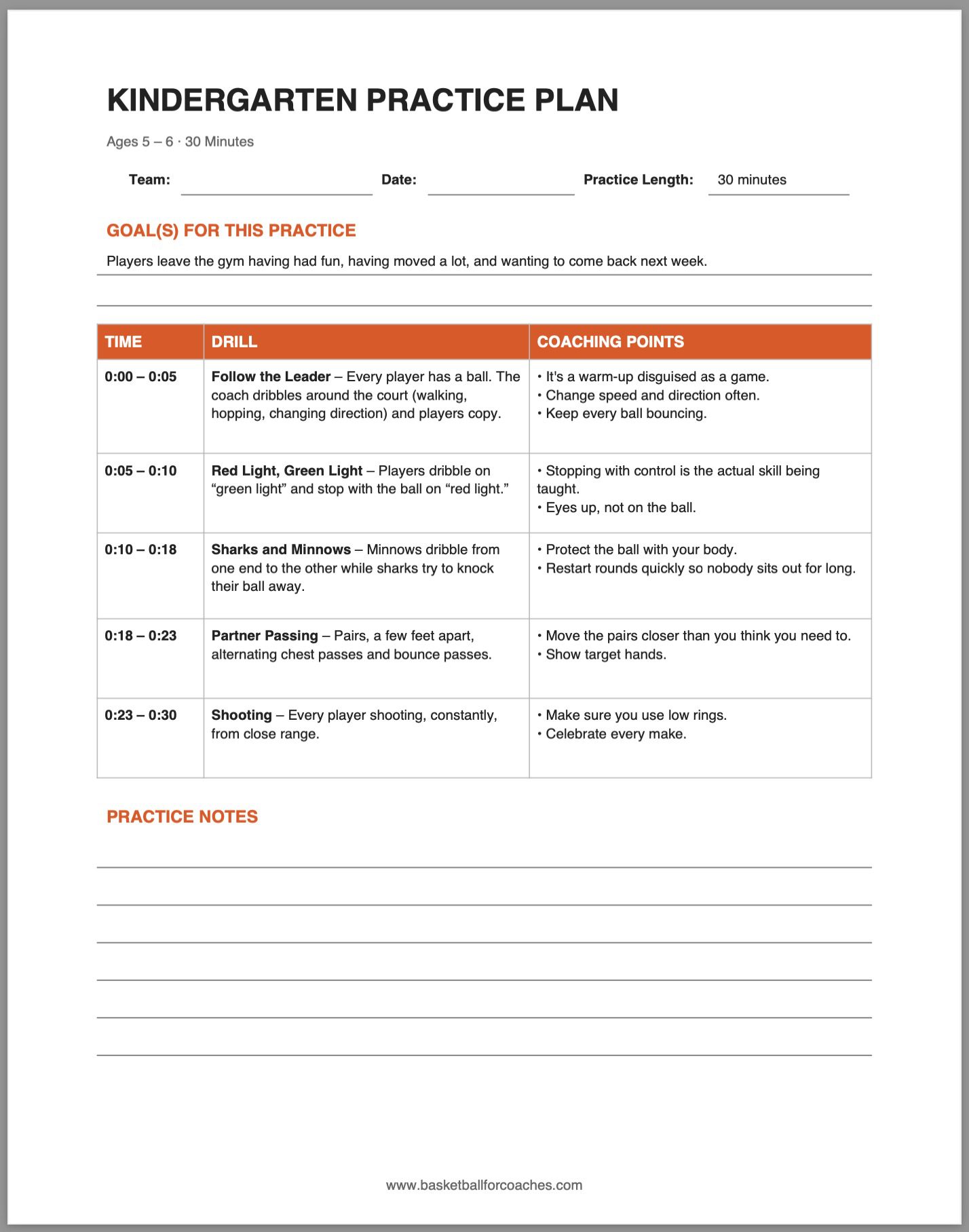
Kindergarten Basketball Practice Plan (Ages 5 – 6)
At this age, forget everything that looks like a "real" basketball practice.
No laps. No lines. No lectures.
A kindergarten practice should be 30 – 45 minutes of games with a ball in every player's hands as often as possible. The goal is simple: they leave the gym having had fun, having moved a lot, and wanting to come back next week.
Here's a 30-minute structure that works:
1. Follow the Leader (5 minutes) – Every player has a ball. The coach dribbles around the court (walking, hopping, changing direction) and players copy. It's a warm-up disguised as a game.
2. Red Light, Green Light (5 minutes) – Players dribble on "green light" and stop with the ball on "red light." Stopping with control is the actual skill being taught.
3. Sharks and Minnows (8 minutes) – The classic. Minnows dribble from one end to the other while sharks try to knock their ball away. Full rules are in our guide to sharks and minnows.
4. Partner Passing (5 minutes) – Pairs, a few feet apart, alternating chest passes and bounce passes. Move the pairs closer than you think you need to.
5. Shooting (7 minutes) – Make sure you use low rings. Every player shooting, constantly, from close range.
For more options, we have a full library of basketball drills and games for kids and fun basketball games.
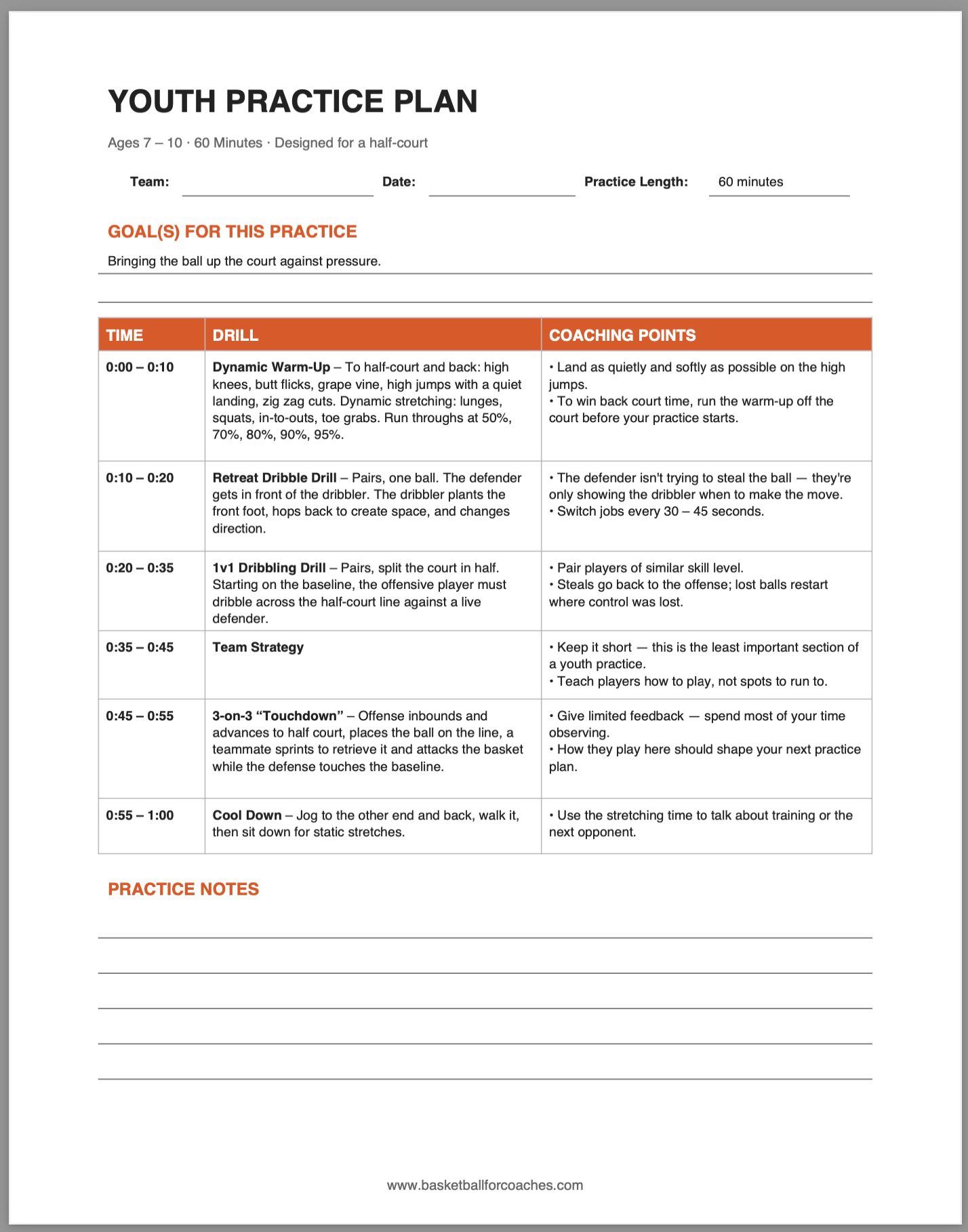
Youth Basketball Practice Plan (Ages 7 – 10)
Disclaimer: This training session has been designed for a half-court, as most teams this young only have access to half the court to train on.
Practice Goal: Bringing the ball up the court against pressure.
Warm-Up (0 – 10 minutes)
Run each of these to half-court and back: high knees, butt flicks, grape vine, high jumps with a quiet landing, and zig zag cuts.
Then dynamic stretching through to half-court: lunges, squats, in-to-outs, and toe grabs.
Finish with run throughs. Half court and back at 50%, 70%, 80%, 90%, and 95% speed.
Skill Work (10 – 35 minutes)
Retreat Dribble Drill (10 – 20 minutes)
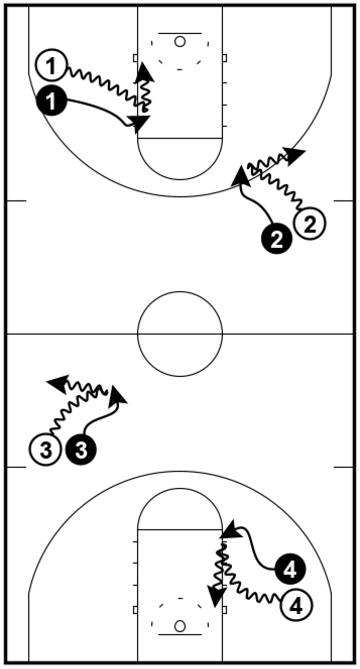
Setup: Pair the players up (similar skill level). One basketball between two players. Spread out around the court.
Instructions:
- Have the player with the ball jog and dribble in any direction. The other player acts as the defender.
- At any moment, have the defensive player sprint and stand directly in front of the offensive player.
- Upon this cue, the offensive player plants their front foot, pushes off it hard, and hops back to create space!
- Have the offensive player change the direction they're dribbling in.
- The defensive player chases the offensive player, and steps in front of them again.
- After 30 – 45 seconds, have the players switch jobs.
Coaching Points: The defensive player isn't trying to steal the ball or truly pressure the offensive player! They are only there to help show the offensive player when they should be making this move.
1v1 Dribbling Drill (20 – 35 minutes)
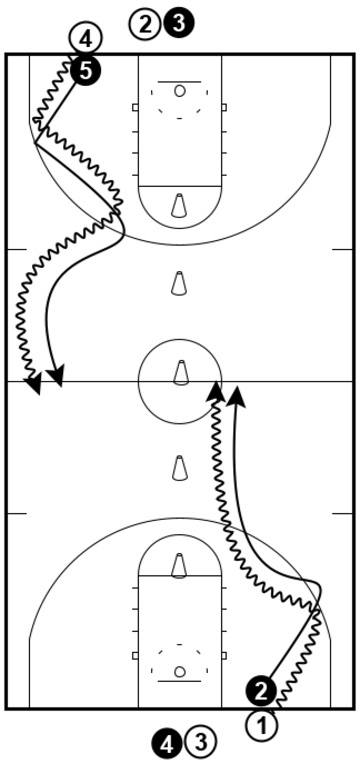
Setup: Pair each player with a similarly skilled teammate. Split the court into two playing halves with an imaginary line between the baskets (use cones to mark if you wish).
Instructions:
- Starting on the baseline, the offensive player must dribble the ball across the half-court line.
- If the defensive player steals the ball, they must give it back to the offensive player.
- If the offensive player loses control of the ball or goes out of bounds, they must retrieve it and start again where they last had control of the ball.
Team Strategy (35 – 45 minutes)
Three options:
Scrimmage / SSG (45 – 55 minutes)
3-on-3 "Touchdown"
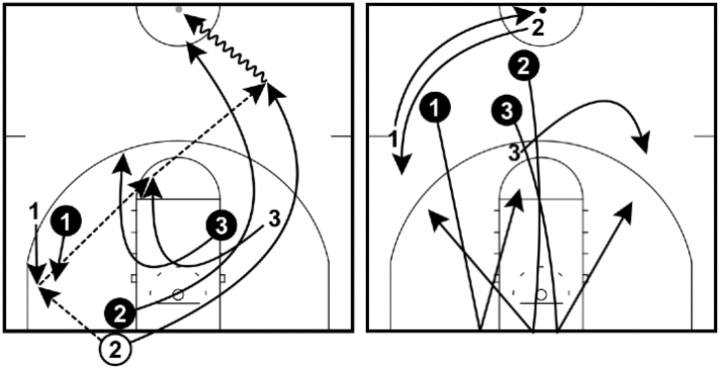
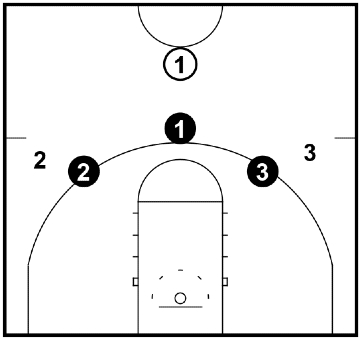
Setup: The offense starts with the ball, out-of-bounds on the baseline. They must inbound the ball, and dribble and pass it to half court.
Instructions:
- If the defense gets the ball, the game stops, and they become the offense.
- The game begins again out-of-bounds on the baseline.
- Once the offense gets the ball to half court, they must place it on the ground, on the half-court line.
- Another offensive player (who didn't place the ball on the ground) must sprint to retrieve the ball. They then turn around and look to score on the basket.
- Once the ball has been placed, the defensive team must all turn around and touch the baseline with their hand.
Coaching Points: As coach, give limited feedback during the game! If you see a certain mistake three times in a row, give advice quickly, but spend most of your time observing. How they perform in this small-sided game should inform how you design your next training session.
Cool Down (55 – 60 minutes)
Jog to the other end of the court and back. Walk to the other end of the court and back. Sit down, and do some static stretches.
The cooldown stretching gives the coach some time to have a conversation with the players about training, and potentially some quick information about the next opponent.
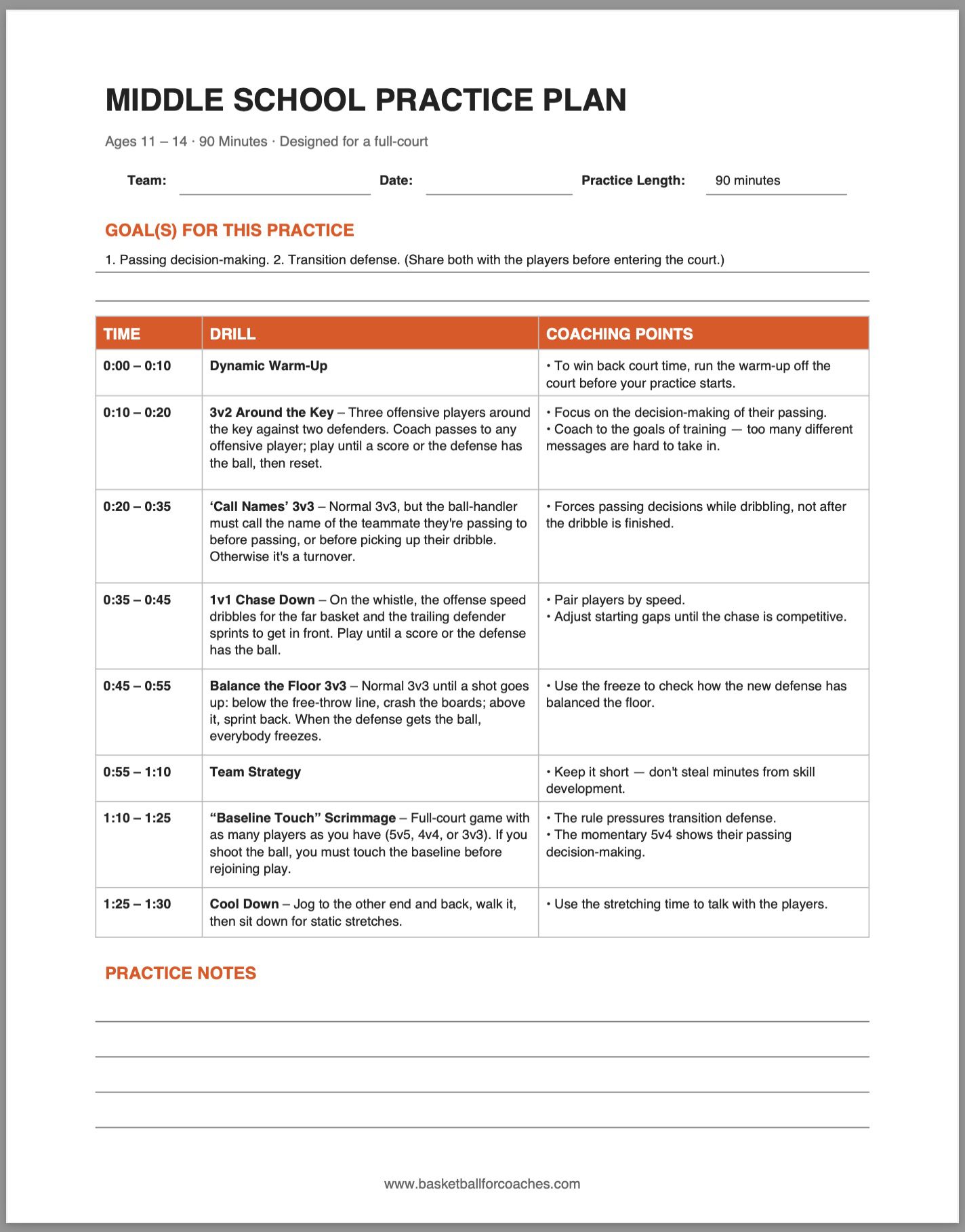
Middle School Basketball Practice Plan (Ages 11 – 14)
Disclaimer: This training session has been designed for a full-court.
Before Practice
Before your time on the court begins, share a very clear goal for training with the players. Each training session should have a purpose. For a 90-minute session, there is enough time for two goals for training.
Example goals: passing decision-making and transition defense.
Warm-Up (0 – 10 minutes)
Same dynamic warm-up, dynamic stretching, and run throughs as the 60-minute plan above.
Skill Work (10 – 55 minutes)
3v2 Around the Key (10 – 20 minutes)
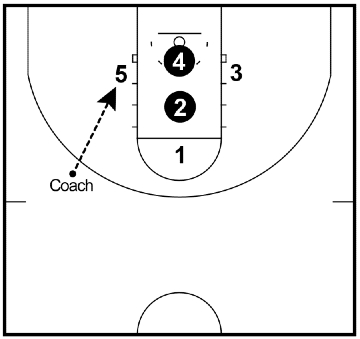
Setup: One offensive player on each block, one starts behind the free-throw line. One defensive player starts under the front of the basket, and the other starts two steps directly in front of him.
Instructions:
- Coach passes the ball to any of the offensive players.
- A game is played until the offense scores or the defense has the ball (or the ball goes out of bounds).
- Everybody chooses a new place to start, and the game begins again when the coach passes the ball.
Coaching Points: Focus on the decision-making of their passing. We have clearly told the players what the goals of training are, and we must coach to that. If you give all kinds of different advice to the players, it'll be difficult for them to take it all in.
'Call Names' 3v3 (20 – 35 minutes)
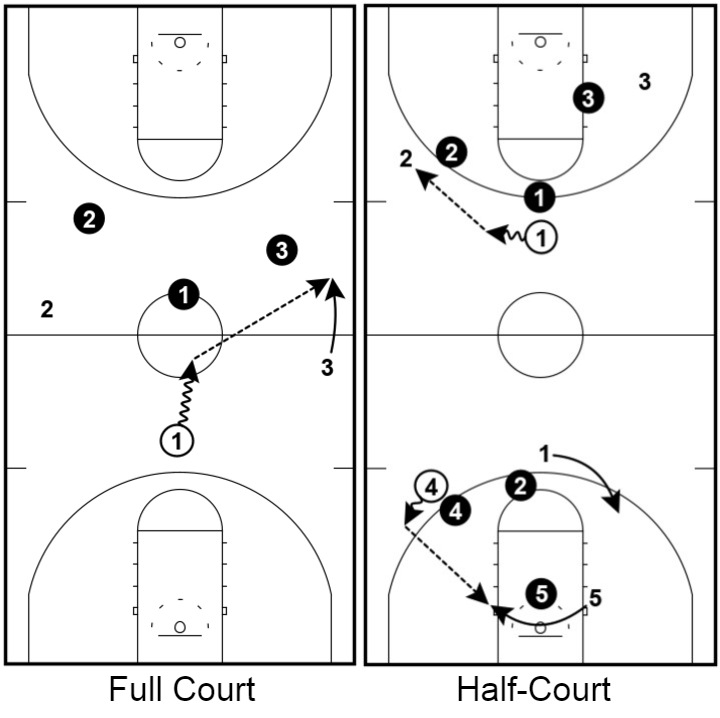
Setup: Depending on numbers and space, play a 3v3 game in the full court, or two 3v3 games in each half-court.
This is a normal 3v3 game, with an extra rule to force the players to make passing decisions while they're dribbling, not after they've finished dribbling.
Rule: The ball-handler must call the name of the teammate they're passing the ball to either (a) before passing the ball, or (b) before they pick up their dribble. If a player passes the ball or picks up their dribble before calling the name of a teammate to pass to, it is a turnover!
1v1 Chase Down (35 – 45 minutes)
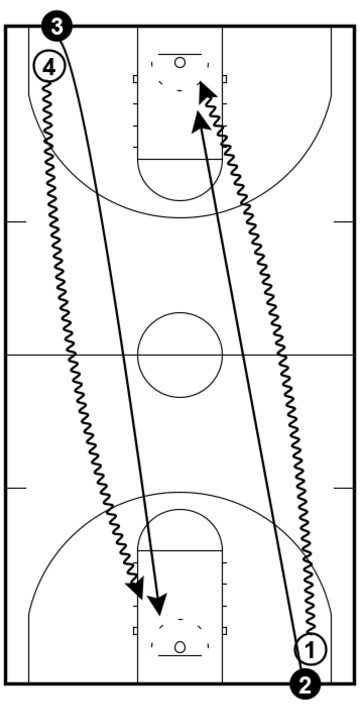
Setup: Pair the players up into similar speed levels. The offense starts a few steps onto the court, either on the left or right side. The defense starts a step or two behind. Depending on the speed of the defensive player and the speed dribbling ability of the offensive player, you'll need to adjust where they begin.
Instructions:
- The coach blows his whistle, and the offense begins speed dribbling towards the basket at the opposite end.
- The defense has to sprint and get in front of the offensive player.
- Play until either the offense scores or the defense has the ball (or the ball goes out of bounds).
Balance the Floor 3v3 (45 – 55 minutes)
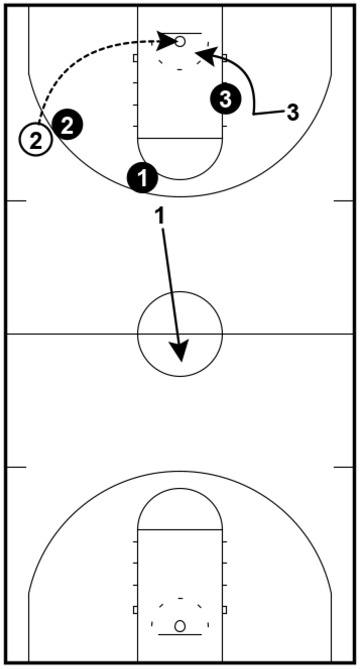
Rules: If you're below the free-throw line when a shot is attempted, go for the rebound! If you're above the free-throw line when a shot is attempted, sprint back onto safety! When either team has the ball, it is a normal game of 3v3.
Instructions: Once a shot is taken, the offensive players must either sprint to the basket and attempt a rebound (if below the FT line) or sprint back towards the half-court line (if above it). If the defense gets the ball, the drill stops, and everybody freezes. If the offense gets the ball, they may shoot it again and continue to play.
Once the defense gets the ball (and everybody freezes), the coach can observe how the offense (who have just become defense) have "balanced the floor."
Team Strategy (55 – 70 minutes)
Three options:
"Baseline Touch" Scrimmage (70 – 85 minutes)
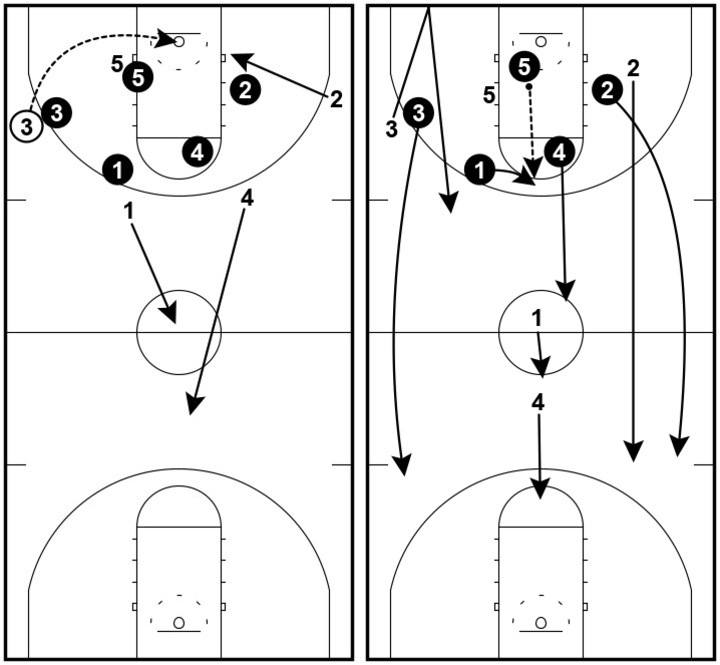
Play a full-court game with as many players as you have! Ideally 5v5, but 4v4 or 3v3 would work too.
To help the game express the goals of training (passing decision-making, transition defense), we add an extra rule:
If you shoot the ball, you must touch the baseline before rejoining the play!
This rule puts more pressure on defensive transition than a normal game. The momentary 5v4 advantage for the offense also allows more opportunities to display their passing decision-making.
Cool Down (85 – 90 minutes)
Jog to the other end of the court and back. Walk to the other end of the court and back. Sit down, and do some static stretches.
High School Basketball Practice Plan (Ages 15 – 18)
Disclaimer: This training session has been designed for a full-court.
Before Practice
Before your time on the court begins, share a very clear goal for practice with the players. For a 120-minute session, there is enough time for three goals for training.
Example goals: 1v1 finishing, full-court man-to-man, and defensive rebounding.
Warm-Up (0 – 10 minutes)
Same dynamic warm-up, dynamic stretching, and run throughs as the plans above.
Skill Work (10 – 70 minutes)
'Read the Help' (10 – 20 minutes)
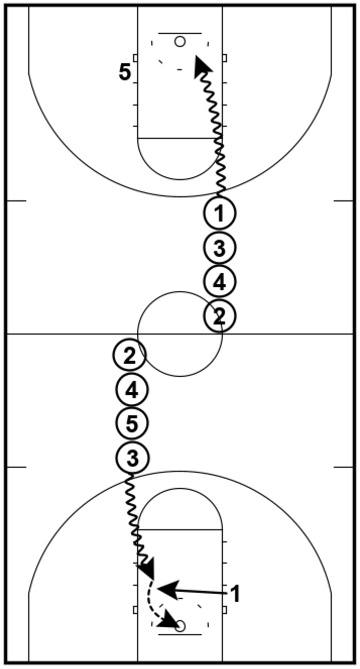
Setup: Spread the offensive players out to both ends of the court, each with a basketball. To work on right-handed finishing, line the offensive players up outside the 3-point line, in line with the right-hand side of the key. One player begins on the left block.
Instructions:
- The first player in line stands in triple threat position, throws the ball down towards their right-hand side, and drives to the basket.
- The player on the left block gives one of three different signals to inform the driving player which finish they should attempt.
- If the player on the left block runs and stands directly underneath the basket, the offensive player makes a powerful move directly to the basket and finishes as high as possible.
- If the player on the left block stands between the driver and the basket (outside the charge circle), the driver shoots a short floater over the top of the defender's head.
- If the player on the left block runs across the key to the right block, the driver makes a change-of-direction move with their footwork and finishes on the left-hand side of the basket — a euro-step or a pro-hop.
1v1 'Ball on Back' (20 – 30 minutes)
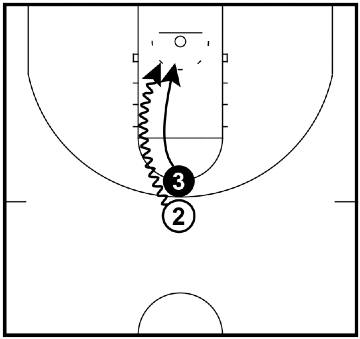
Setup: The defender stands on the 3-point line, facing the basket. The offensive player stands behind the defender and places the ball on the defender's back.
Instructions:
- The drill begins when the offensive player takes the ball off the defensive player's back.
- Play until either the offensive player scores or the defensive player gets the ball.
- The defender facing away gives the offensive player an advantage, which they take with a fast, decisive move to the basket!
2v2 'Rugby' (30 – 45 minutes)
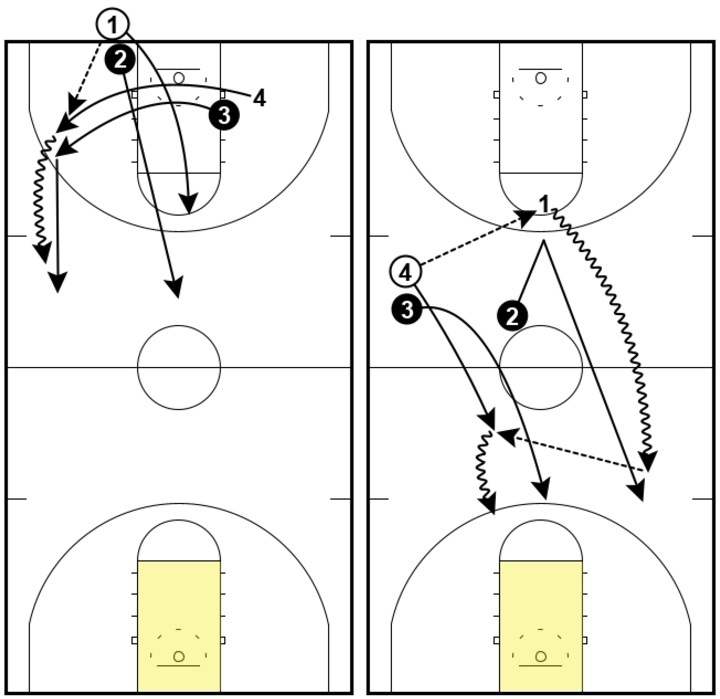
Setup: The ball starts out of bounds on the baseline.
Instructions:
- The offensive inbounder must pass the ball into the court to his teammate.
- After this first pass, the offensive team may only pass backwards.
- The goal is to get the ball into the key at the other end of the court.
- The defensive team works on having a player closely guarding the ball, with his teammate behind the line of the ball, narrowing the space the offensive player has to dribble.
3v3 'Hockey' (45 – 60 minutes)
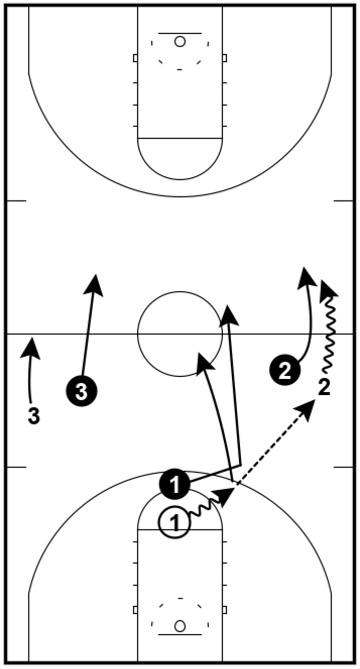
This is a game of 3v3 in the full court, with one extra rule which allows the defense to apply more full-court pressure.
Rule: Borrowing from ice hockey's offside rule, the offensive ball-handler must be the first offensive player to cross the half-court line. Before the ball is dribbled across the half-court line, no other offensive player may be in the front half of the court.
This prevents offensive players from sprinting ahead for easy long passes, and allows the defense to practice their full-court defense more effectively.
Find, Hit, Get (60 – 70 minutes)
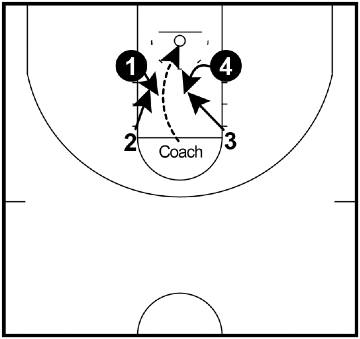
Setup: Two players start on the top corners of the key (offense), and another two players start on the blocks (defense).
Instructions:
- Coach shoots the ball from the foul line.
- Once the ball is shot, all 4 players can move to rebound.
- Upon the shot, the two defensive players yell: "FIND!" and run towards the offensive players. "HIT!" and make contact with the offensive players. "GET!" and attempt to rebound the ball.
- Whichever team gets the ball becomes offense, and attempts to score on the basket the ball was just shot upon.
- Players rotate positions after either team has scored.
Team Strategy (70 – 90 minutes)
By the time your players are 15 or older, they'll need a couple of set plays to score with. If you don't already have a few plays up your sleeve, check out 28 basketball plays to dominate any defense.
When practicing set plays, make sure to use all the players you have available!
5v0 might make your plays look great... but they won't look great once you get to the game.
Practice your plays with defenders.
To begin with, have them not steal the ball or try and blow up your play, but make sure you build towards practicing your plays against a live defense. If you only have 8 players at training, 3 defenders is better than 0 defenders!
Scrimmage / SSG (90 – 115 minutes)
With 3 different focuses for this training session, we use small-sided games and a 5v5 scrimmage to apply what we've learned.
3v3 Small-Sided Game (90 – 100 minutes)
To emphasize finishing at the basket, we change the scoring system:
- Score inside the bottom half of the key = 3 points.
- Score inside the top half of the key = 2 points.
- Score inside the 3-point line, but outside of the key = 1 point.
- 3-point basket = 0 points, but the opponent's score goes back to 0.
Making mid-range baskets only worth 1 point encourages players to keep driving and not settle for pull-up jump shots. Creating a large consequence for giving up a made 3-point shot causes the defense to close out harder, creating more driving opportunities for the offense.
5v5 Scrimmage (100 – 115 minutes)
To focus on full-court defense and rebounding, we introduce two simple rules:
Rule 1: Once the defense first gets the ball (on a made basket, a rebound, or a steal), the player who has the ball must place it on the ground. Another teammate runs across and picks up the ball, and the game resumes. The new defense cannot defend the ball until it has been picked up by the other team. This gives the defense a chance to set up their full-court defense on every change of possession.
Rule 2: If the offensive team gets an offensive rebound, they get a "power play" — a free chance to score without any threat of losing the ball. Once the defense has the ball (on a rebound or a steal), the game stops, and the offense gets the ball back.
Coaching Points: We recommend that you play mini-games and coach in between each game. Play until either team has scored two baskets, bring the teams in, and coach them for 30 – 45 seconds. Make substitutions and send them back out onto the court!
Coach in dot-points, not paragraphs.
Cool Down (115 – 120 minutes)
Jog to the other end of the court and back. Walk to the other end of the court and back. Sit down, and do some static stretches.
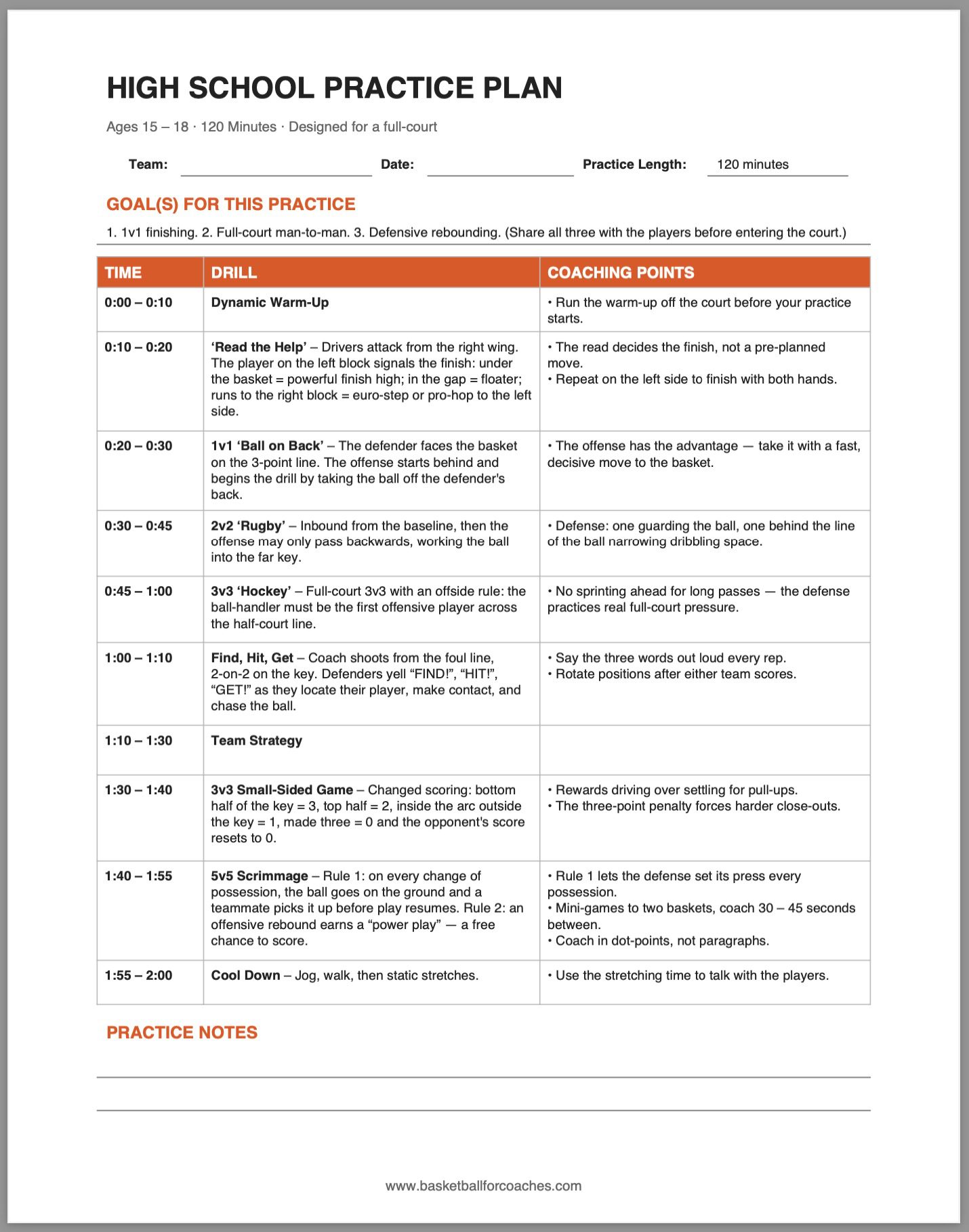
Basketball Practice Plan Template
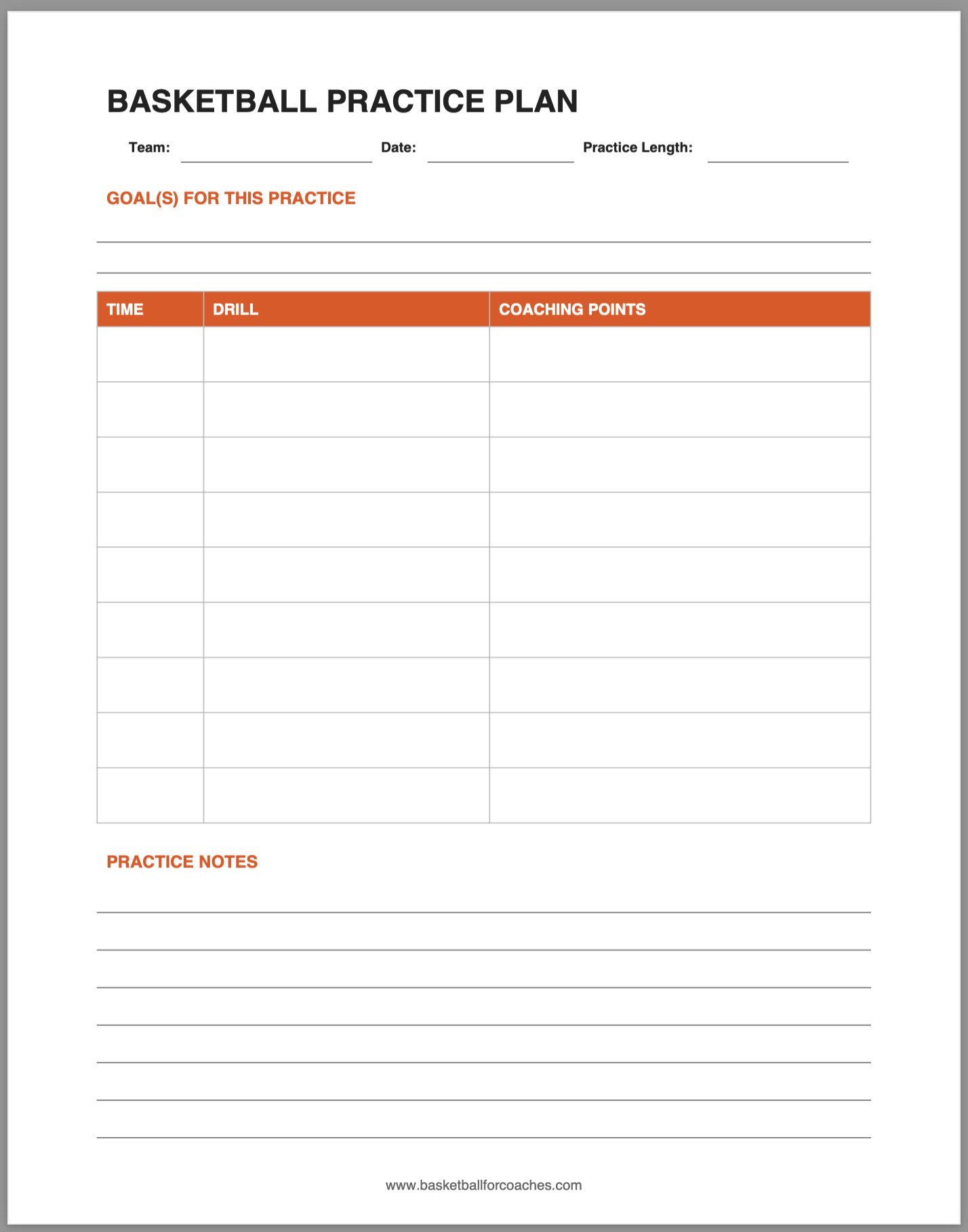
Every practice plan template I use has just three columns:
1. Time – Exactly how much time you plan to spend on the drill.
2. Drill – Which drill you plan to run, with a brief description.
3. Coaching Points – The points of emphasis you must remember throughout the drill.
That's it.
When I first started coaching, I went the other way...
4 – 5 page practice plans breaking down exactly how to run each drill, where every player should stand, what color each player must be wearing.
Those plans were taking me close to two hours to create. For a U12 team.
To quote John Thompson:
"Keep it simple. I'm not interested in trying to prove to my players that I'm a genius" – John Thompson
He wasn't talking about practice plans, but the advice fits perfectly. Three columns on one page, filled out in 15 – 20 minutes at your dining table the night before. That's a practice plan.
Your Plan Is a Guide, Not a Script
"You should formulate a game plan going in, but much of your team's success depends on your ability to make efficient and effective adjustments" – Roy Williams
"I have a plan of action, but the game is a game of adjustments" – Mike Krzyzewski
Both coaches were talking about games, but the wisdom applies equally to practices.
No practice unfolds exactly as expected. Maybe your players are sluggish, so you insert a competitive drill to get them locked in. Maybe they're benefiting from a drill so much that extending it is worthwhile. Maybe a drill is too difficult, so you switch to something else.
The real value of writing a plan is that it forces you to identify what your team needs and prioritize drills that target those needs. Once practice begins, the best coaches adjust.
The Post-Practice Review
After practice, block off 10 – 15 minutes and answer these three questions:
1. Was it a good or bad practice? – If good, what made it good? A drill the kids loved? More games than usual? If bad, were the players tired, bored, standing in lines too long?
2. What can you learn from today's practice? – Perhaps you realized your players were distracted because they spent too long waiting for their turn.
3. How can you improve future practices? – Knowing that, next practice you choose drills that involve more players at once.
Do this after every practice and your plans improve week after week.
Frequently Asked Questions
How long should a basketball practice be?
For most youth teams, 60 – 90 minutes is ideal.
Kindergarten and beginner teams should practice for 30 – 45 minutes, while high school teams can handle 120 minutes.
Whatever the length, the 50/25/25 structure stays the same. The minutes just scale up or down.
What is a good basketball practice plan for kids?
A good kids' practice plan spends at least half of practice on skill development through fun drills and games, keeps every activity under 10 minutes, and finishes with small-sided games like 1v1, 2v2, and 3v3.
Skip set plays entirely for players under 10.
The youth plan and kindergarten plan above are complete examples you can use today.
What if my team only gets one hour of practice a week?
The problem is usually not that we have short practices, but that we waste time (as Seneca almost said).
Three fixes:
1. Warm Up Off the Court – Run the warm-up and team talk before your slot starts. That alone can win back 15 – 20 minutes.
2. Split the Formula – If you get two short sessions instead of one long one, use day one for skill work plus a small-sided game, and day two for strategy plus a scrimmage.
3. Share a Court – Ask around your league about splitting a full court with another team. Two half-court practices a week beats one full-court practice... and you can finish each session scrimmaging against each other.
And before complaining about a lack of practice time, audit your current plan.
A team spending 30 of its 60 minutes on set plays doesn't have a time problem.
Should a basketball practice plan include conditioning?
Not as its own section. Your players get most of the conditioning they need from high-intensity drills and small-sided games while working on other skills at the same time.
Unless you have an enormous amount of practice time, standalone conditioning drills take minutes away from skill development your team can't afford to lose.
How often should you change your practice plan?
Write a new plan for every practice, but don't reinvent the structure. The sections and time splits stay consistent all season.
Rotate individual drills every few weeks so practices stay fresh, and let your post-practice reviews tell you which drills have stopped earning their minutes.
Conclusion
The biggest thing I want you to take away from this article is that you need a basketball practice plan for every practice.
It doesn't need to be complicated:
Half of practice on skills, a quarter on strategy, a quarter on games. Three columns on one page. Fifteen minutes at the dining table the night before.
A planned practice is more efficient, your players will improve quicker, and you'll be a far better coach.