
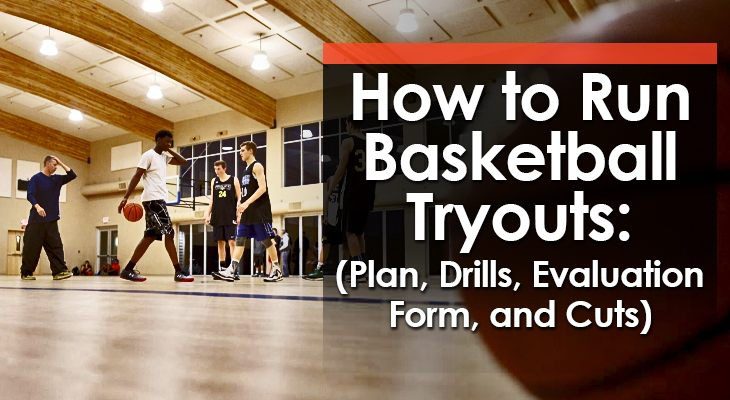
Basketball tryouts are the sessions a coach runs before the season to evaluate players and select the team.
A good tryout is half skill drills and half competitive games, runs across two or more short sessions, and uses a simple evaluation form so every player gets a fair look.
That sounds obvious. Most tryouts I hear about are nothing like it.
In this guide, I'll show you how to plan basketball tryouts, which drills to use, what to look for in players, how to score them, and how to handle cuts when you have no other choice.
What Are Basketball Tryouts For?
Tryouts exist so you can select the best team.
Not the most talented players... the best team.
Here's the thing most coaches won't say out loud:
The first 5-7 spots will be decided within the first ten minutes of tryouts. You'll know who the best players are almost immediately.
Tryouts are really about the last three to five spots.
If you're coaching at the HS level or above, where playing time isn't distributed evenly, those final spots matter more than most coaches realize. They're the players who push your rotation in practice, step in when someone's injured, and set the tone on the bench.
That's where coachability, attitude, and work ethic stop being talking points and start deciding selections.
At youth level, every player who makes the team should get fair minutes. So the final spots are less about who can accept a bench role and more about who will keep improving and keep the group positive.
Either way, structure your tryouts to give you a clear look at the middle of the group. The top players will take care of themselves.
How to Plan Basketball Tryouts
The tryout itself is the easy part. Most of the mistakes happen before anyone walks into the gym.
1. Run Multiple Short Sessions – Two 60-minute tryouts are far better than one 120-minute tryout. You need time between sessions to step away, process what you saw, and plan what to look for next time. A second session also strips away the "bad day" excuse from players and parents.
2. Compare Mock Selections Between Sessions – If more than one coach is evaluating, have each of you write down a mock team after session one. Then compare. You'll immediately find the players everyone agrees on and the players you're conflicted about. Those are the ones who need the most attention in session two.
3. Find Someone to Help – Every new coach should have a second set of eyes. Ask an experienced coach you trust. They'll run drills while you step back and watch, and give you a second opinion at selection time. You'd be surprised how willing most coaches are to help if asked.
4. Give Every Player a Clean Slate – Don't walk in with the team already picked from last season. Some players work incredibly hard over the off-season. It's only fair they get a clean record to prove it.
5. Prepare the Session in Advance – Know roughly how many players are coming and have every drill planned before you arrive. Tryout time is limited. Don't waste any of it deciding what to do next.
6. Don't Cut Anyone If You Can Avoid It – Youth basketball is about participation. If you have too many players, create two teams. If you have two or three too many for one team but not enough for two, keep everyone and rotate players out of a tournament each. There will be times you have no choice (high school, senior teams), but cutting should be the last resort.
How to Introduce Yourself at Tryouts
For many new coaches, the introduction is more stressful than the tryout. Here's a short script that covers everything:
a. Gather everyone together – Players and parents at one end of the court.
b. Welcome them – "My name's Coach Mac. Great to see you all here today."
c. Share your coaching philosophy – Two or three sentences. How you play, how you distribute minutes, what the season is about. Skip credentials if you don't have any yet.
d. Explain how tryouts will work – How many sessions, when they are, how long each one runs, and what a session looks like (skill drills, then games).
e. Say what you're looking for – Pick two or three traits and name them. "Players who listen and learn, players who support their teammates, players who love to compete."
f. Explain selections – When and how the team will be announced.
g. Ask for questions – Then get started.
That's it. Short and sharp. The deeper philosophy conversation can wait for a pre-season meeting once the team is picked.
Basketball Tryout Drills
Let me clear something up first:
There's no such thing as a "tryout drill."
There are no magical evaluation drills I use during tryouts and then throw away for the rest of the season.
Some drills are better than others for finding out who can actually play... but they're the same drills you'd use at any practice.
What matters is the mix.
The in-season practice plan structure I recommend is 50% skill development, 25% strategy, 25% games...
For basketball tryouts, cut strategy out completely.
50% skill drills. 50% competitive games.
The skill drills let you evaluate technique. The competitive games show you who can put the ball in the hoop.
Here are a few drills I recommend:
1. Dribble Tag – Every player with a ball inside the half court, dribbling while trying to tag others. Fun, fast, and it shows you ball control with eyes up in a crowd.
2. 3-on-2 Full Court – Three attackers against two defenders the length of the floor. This is the drill that exposes decision-making: who passes at the right time, who forces it, and who runs the floor hard both ways. It also tells you plenty about conditioning without running a single sprint.
3. 2-on-2 Box Out – Coach shoots, two offensive players attack the glass, two defenders box out and rebound. Rebounding is under-tested at tryouts and it reveals toughness faster than anything else.
4. 4-on-3 Advantage – Offense has a numbers advantage, defense scrambles. The high-IQ players on offense find the open man immediately. The high-IQ defenders anticipate the pass before it's thrown.
5. 3-on-3 Half Court – Regular rules, and also consider switching to a maximum of three dribbles per touch. This forces players to move without the ball, which is what they'll be doing for most of every game. On defense, you'll see who can guard the ball AND their man.
6. Competitive Shooting – Any shooting drill with a score. Partner races to 10 makes, team shooting to a target, whatever you normally use. Skill drills should still have a winner.
7. Full-Court 5-on-5 – Short games, first to 5 or five minutes. Save it for the end of the session, and use it to focus on the bubble players rather than the whole floor.
If you want more competitive options, the small-sided games page explains why they work so well, and the scrimmage guide covers constraints you can add to 5-on-5.
A Sample Basketball Tryout Plan
Here's a 90-minute session that follows the 50/50 rule. Skill drills and competition overlap in most of these, which is exactly what you want.
0-10 min – Dynamic Warm-Up
10-20 min – Dribble Tag – Ball handling under pressure.
20-35 min – 3-on-3 Half Court – First with regular rules, and then three-dribble maximum so you can see movement without the ball.
35-45 min – Competitive Shooting – Partner or team shooting drills with a score.
45-60 min – 3-on-2 Full Court – Decision-making and conditioning.
60-70 min – 2-on-2 Box Out – Rebounding and toughness.
70-90 min – 5-on-5 – Short games. Watch the bubble players.
Don't overcomplicate it. If it's a group you mostly already know, swap in drills they already know how to run... the fewer new drills you have to explain, the more time you spend evaluating.
Session two should look similar, but adjust it based on what you learned in session one. If the coaches disagreed about three players, build in more 3-on-3 and 4-on-3 so you see those three in smaller groups.
What Coaches Should Look For at Tryouts
"What to look for" depends on age group, the system you run, and the level of competition. But here's my general list:
1. Players Who Can Put the Ball in the Hoop – Skill is by far the biggest factor. Not the best footwork or the prettiest jump shot, but the players who consistently score in competitive games. You only find them by playing games.
2. Players With Physical Tools – This one ruffles feathers, but if a 12-year-old walks in a foot taller than everyone else, I'm picking him regardless of how raw his skills are. Athleticism, length, and speed are almost impossible to teach. Skills aren't.
3. Players Who Show Competitive Fire – I love coaching players who want to win. More often than not, these are also your best defenders. There's no such thing as a great defender who isn't competitive.
4. Players Who Can Follow Instructions – Coachability. Can they accept feedback and apply it on the next possession? Do they want to learn?
5. Players With Positive Energy – The season is long. You'll spend a lot of early mornings and late nights with this group. Pick people who keep team morale high.
A quick word on the "character over skill" line you'll hear from coaches: No coach running a competitive team picks the polite new kid with no skills over last season's leading scorer. Skills fill the first 5-7 spots. Character decides the final two or three, when you're choosing between four players of similar ability. That's where the intangibles matter... and matter a lot.
If you want more perspectives, 28 experienced coaches shared their tryout advice here.
Also, Don't Be a Prison Guard
Here's a mistake I see coaches make at nearly every tryout:
They spend the whole session standing against the wall, scribbling on evaluation sheets, whispering to assistants, strolling the sideline with their hands behind their back.
More prison guards than basketball coaches.
The problem?
You can't evaluate coachability without coaching!
Give instructions. Correct a player's stance. Tell someone to sprint back on defense. Then watch what happens next. Do they take it on board, or forget it five seconds later? Who WANTS to be coached?
Balance instruction and evaluation. You'll learn things about each player you'd never see from the wall.
Basketball Tryout Evaluation Forms
A basketball tryout evaluation form keeps every coach scoring players on the same criteria, and gives you notes to justify your decisions if a parent or administrator asks.
You should use one... but understand this first:
Evaluation forms are good servants but bad masters. They're a useful tool, never the final authority. Picking a team takes a coach's judgment, your assistants' opinions, and what you saw in the competitive games. The form supports that. It doesn't replace it.
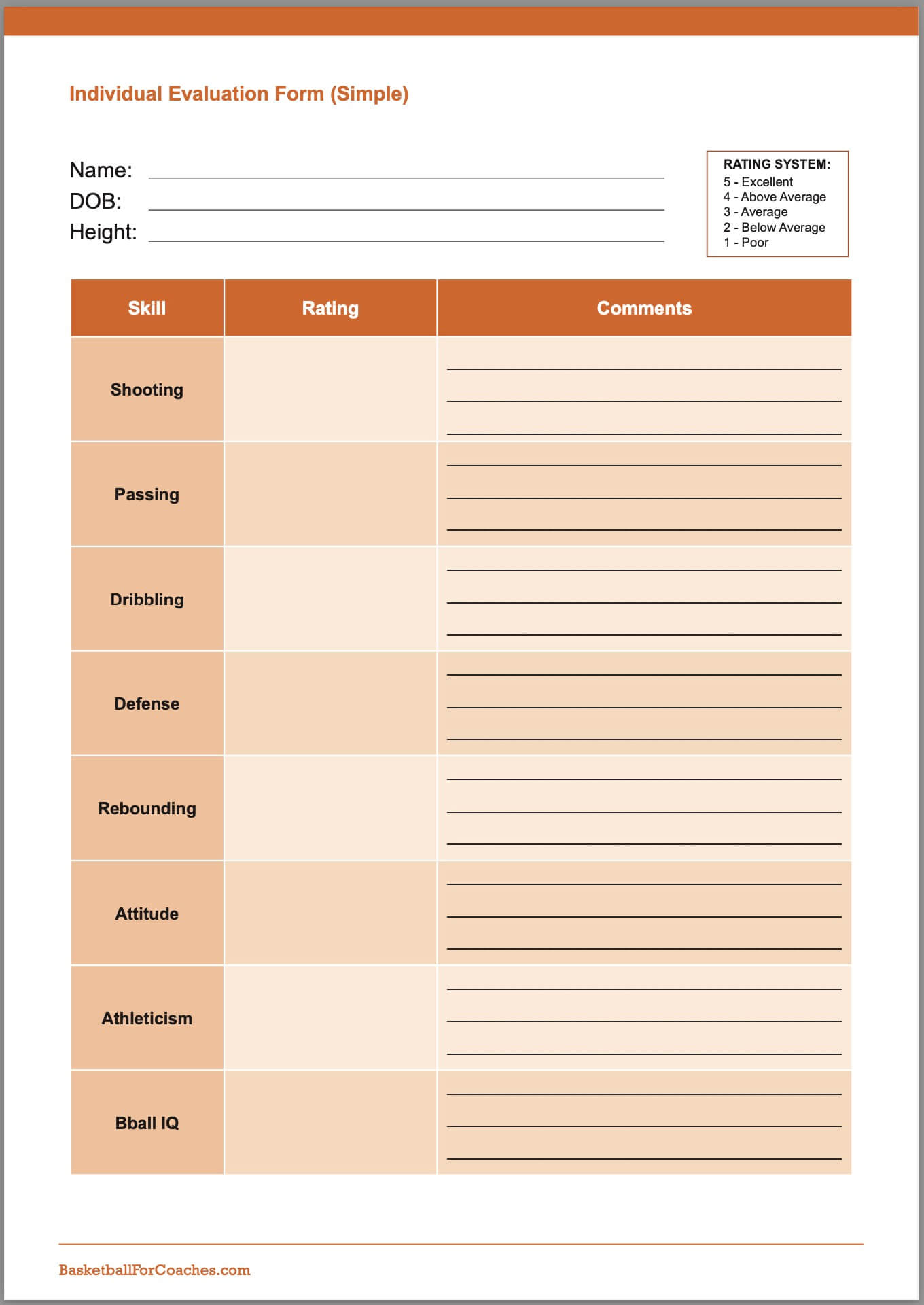
Here's what to score, 1-5 (Poor to Excellent):
- Shooting
- Passing
- Dribbling
- Defense
- Rebounding
- Attitude
- Athleticism
- Basketball IQ
Plus a comments column. Two or three lines per player. The most valuable part of the sheet.
There are four versions worth considering:
1. Individual (Simple) – One player per sheet, the eight categories above, a comments line for each. Best for small groups where you can spend real time on every player.
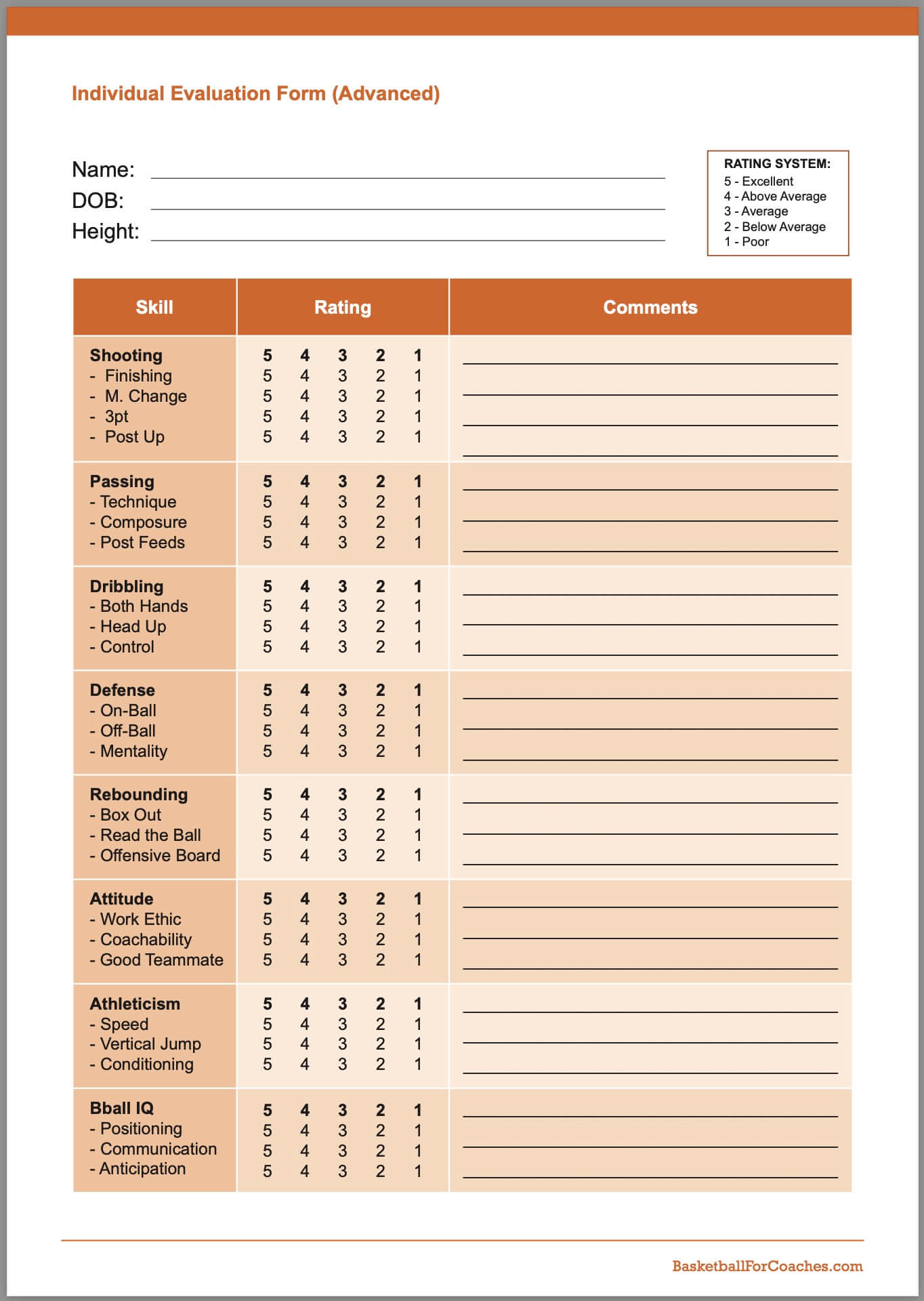
2. Individual (Advanced) – The same eight categories broken into sub-skills. Shooting becomes finishing, three-point, post-up. Defense becomes on-ball, off-ball, mentality. Use it for older groups or when you're picking between similar players.
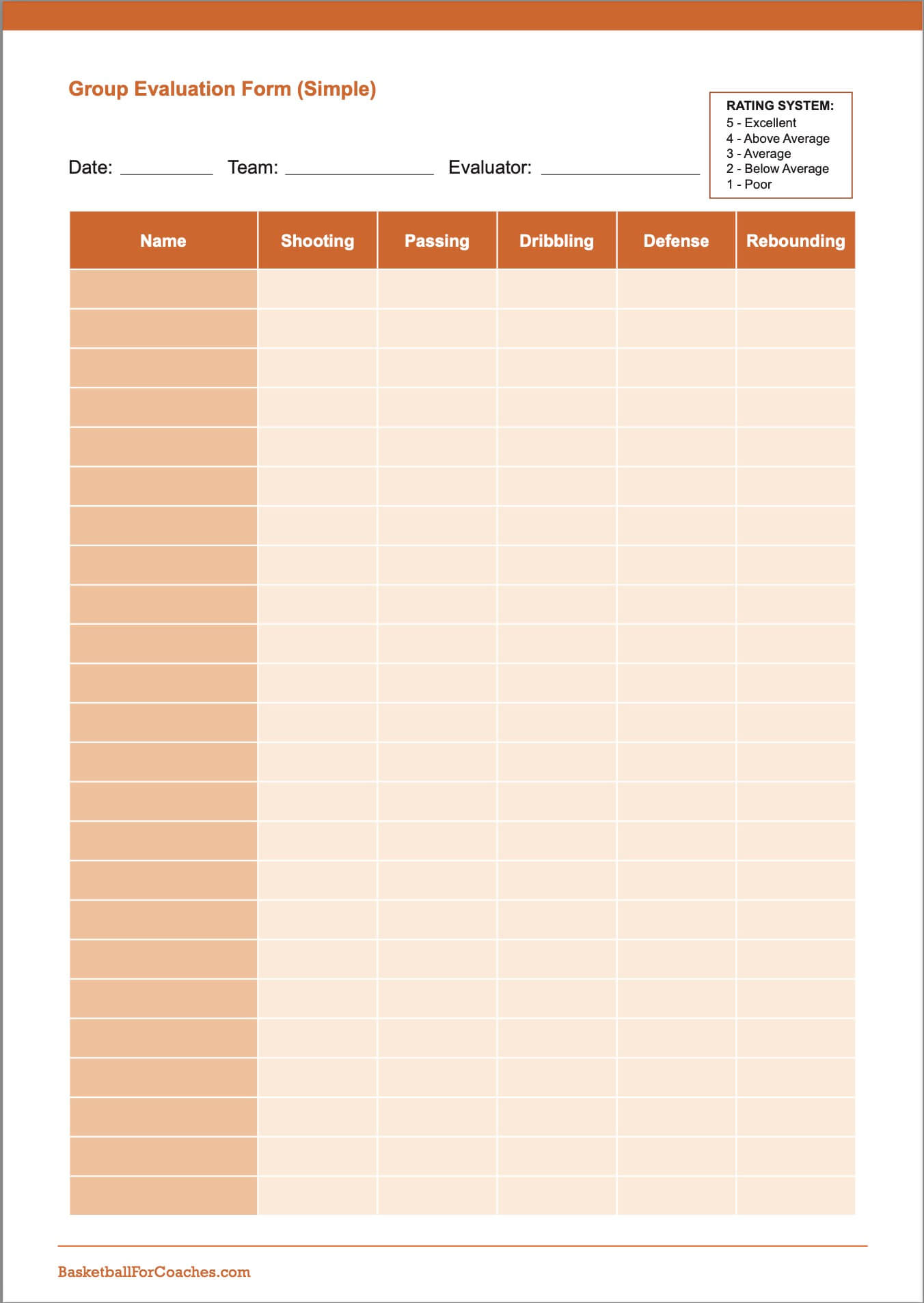
3. Group (Simple) – Every player on one sheet, five skill columns. Best for 20+ players when you need to score fast between drills.
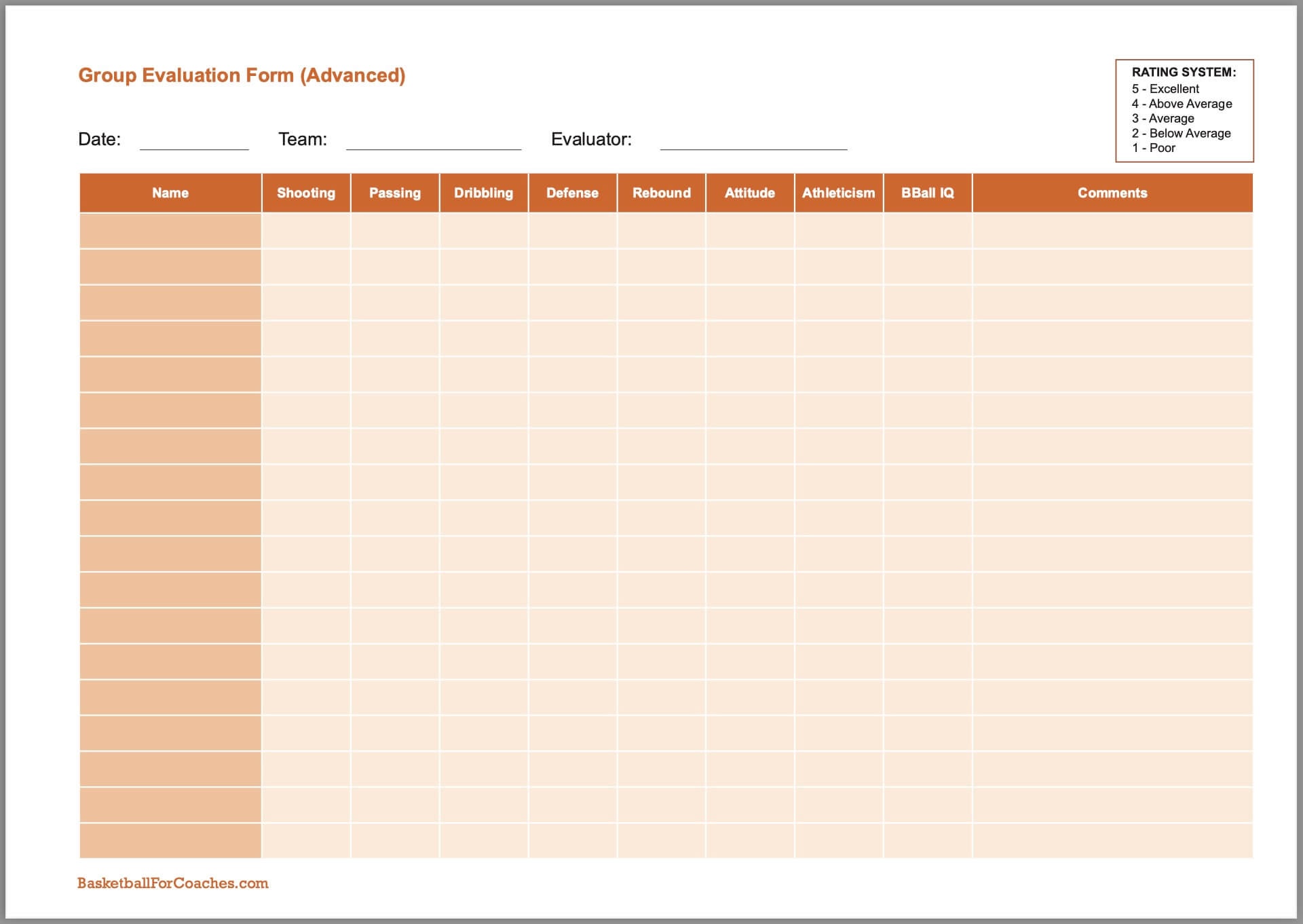
4. Group (Advanced) – Every player on one sheet with all eight categories and a comments column.
From Scores to Selections
Once the forms are filled in, sort every player into one of three piles based on basketball ability alone:
1. Definitely on the team.
2. Might be on the team.
3. Won't be on the team.
Don't do this before tryouts start. Every player gets fresh eyes. But you should have a good idea after the first session.
Here's why it matters:
80% of your attention should go to the "might" pile. If 20 players show up and you're picking 10, you'll typically have 7 obvious selections, 7 obvious cuts, and 6 in the middle for the last 3 spots. Those 6 are the whole job. Plan session two around getting a clear look at them.
When you're choosing between the maybes, weigh these in order:
1. Basketball Skills – The form covers this. Compare players to each other and see who comes out on top.
2. Natural Feel – Some players don't look skilled in technical drills but dominate the competitive games. Wonky jump shot, but they score. Lost on defense, but they get steals. Note who's always in the right place and who keeps ending up on the winning team.
3. Character – Coachable, hard-working, a good teammate, positive body language. These players improve fast, and it matters most for the final spots, where players will spend time on the bench.
4. Positional Fit – If you're choosing between a point guard and a center of similar ability and you already have two strong point guards, take the center. They'll fill a role and get minutes.
Also, Never Hand the Form Out!
Once the evaluation forms have helped you pick the team, they go in the shredder.
Do not give them to players. Do not give them to parents.
The scores are subjective and situational. The moment a parent has the sheet, every category they disagree with becomes THE reason their kid didn't make it. You do not want to be in that conversation.
Give feedback instead. Tell every player who didn't make the team that they're welcome to come and talk to you about why, and what to work on. That way you can be honest without comparing them to anyone else.
How to Cut Players After Tryouts
Cutting players is the worst part of coaching. Here's how to make it as fair as possible.
1. Avoid It If You Can – Two teams, or rotating players out of tournaments, beats cutting at youth level every time.
2. Tell Them Face to Face – Not by email, not on a list on the gym door. If you can't meet every player individually, at least tell them yourself.
3. Be Honest About Why – Keep it short and specific. What they can work on for next year is more useful than a soft letdown.
4. Offer Another Role – A player you cut who clearly loves the game can be a team manager, keep stats, or practice with the team. Injuries and dropouts happen, and that player is first in line.
5. Keep the Door Open – Kids cut from a middle school team become varsity starters all the time. Make sure they know that.
Basketball Tryout Tips for Players
Everything above is written for coaches. But if you're a player reading this, here's what the coaches watching you actually notice.
1. Arrive in Shape – Tryouts involve a lot of running and transition play. If you're in peak condition before day one, you can focus on playing well instead of surviving.
2. Arrive Early and Get to Work – Introduce yourself to the coach if you don't already know them, then start form shooting or a ball-handling routine. Nobody is impressed by half-court heaves before practice.
3. Watch Your Body Language – Coaches place a huge premium on this. Make eye contact, nod when you're spoken to, and don't pout after a missed shot or a no-call. If you look easily rattled, it hurts your chances.
4. Be the Loudest Player in the Gym – Talk on defense on every possession. "Ball," "help," "screen left." Encourage teammates between drills. A talking defender is usually an engaged defender, and coaches want great teammates.
5. Play to Your Strengths – Know what you do well and show it. If you're not a shooter, don't throw up wild threes. If you're the best rebounder in the gym, make sure everyone knows it by the end of the session. (Who cuts the best rebounder on the team?)
6. Sprint the Floor Every Possession – Run hard in transition both ways. You don't need to be the fastest player, but players who take off immediately have a big advantage over those who ball-watch.
7. Do the Little Things – Take a charge. Dive on a loose ball. Battle for rebounds. Everyone has a poor shooting day, so don't rely on making shots to get noticed.
8. Compete – Tryouts are a competition. Do YOUR best in every drill and scrimmage, and let the coaches see it.
Basketball Tryouts FAQ
What do you do at basketball tryouts?
A typical basketball tryout is a mix of skill drills (dribbling, shooting, passing) and competitive games (3-on-3, 3-on-2, 5-on-5). Coaches use the drills to evaluate technique and the games to see who can actually play. Expect a short introduction from the coach at the start, and expect to be watched in everything you do... including how you react to mistakes and instructions.
How long do basketball tryouts last?
A single session should run 60-90 minutes. Two or three sessions over a week is ideal. One long tryout is worse than two short ones because coaches need time between sessions to process what they've seen.
What should players wear to basketball tryouts?
Basketball shoes, athletic shorts, and a plain shirt (most coaches will hand out singlets/bibs). Bring water. Nobody is picking a team based on what you're wearing.
How can a player stand out at basketball tryouts?
Compete on every possession, talk on defense, sprint the floor both ways, and encourage teammates. Coaches notice effort and communication before they notice skill.
When are high school basketball tryouts?
In the United States, most high school basketball tryouts run in late October or early November, a few weeks before the season starts. Middle school and club tryouts vary widely, so check with your school or program directly.
What are AAU basketball tryouts?
AAU basketball tryouts are selection sessions for club travel teams, usually held in spring before the summer tournament season. They follow the same format as school tryouts but are often more competitive because players come from multiple schools.
Conclusion
Running basketball tryouts well isn't complicated.
Plan two or three short sessions. Split each one between skill drills and competitive games. Use a simple evaluation form during the session, then rank players at the end. Coach while you evaluate so you can see who's coachable.
And remember what tryouts are really for... finding the players who can play, not the players who look good in a drill.
Do that and you'll pick the best team in the gym.