

A full-court press is a defensive strategy where your team pressures the opposition for the entire length of the court, instead of retreating and setting up in a half-court defense.
Coaches press for two main reasons: to force turnovers and to control the tempo of the game.
A press can be run man-to-man or as a zone... and when a well-drilled team commits to one, it can completely take an opponent out of their rhythm.
In this guide, I'll break down the different types of full-court press, the key strategies for running one effectively, when to use it, and the situations where pressing does more harm than good.
What Is a Full-Court Press?
Most teams defend the same way after a score: all five players turn and SPRINT back past the half-way line, set up their half-court defense, and wait for the offense to come to them.
A pressing team does the opposite.
The defense picks up the offense immediately... pressuring the inbound pass, crowding the ball-handler, and often trapping with two defenders to force a turnover or a bad decision.
Pressure can be applied man-to-man, where every defender guards a direct opponent the full length of the floor. Or as a zone press, where defenders start in a set formation and guard areas of the court.
Both approaches share the same goal:
Make every pass and every dribble a battle, and never let the offense get comfortable.
Full-Court vs 3/4-Court vs Half-Court Press
Not every "press" starts at the baseline.
Presses are grouped by where the defense picks up the basketball, and many programs use a simple numbering system to call them out during games:
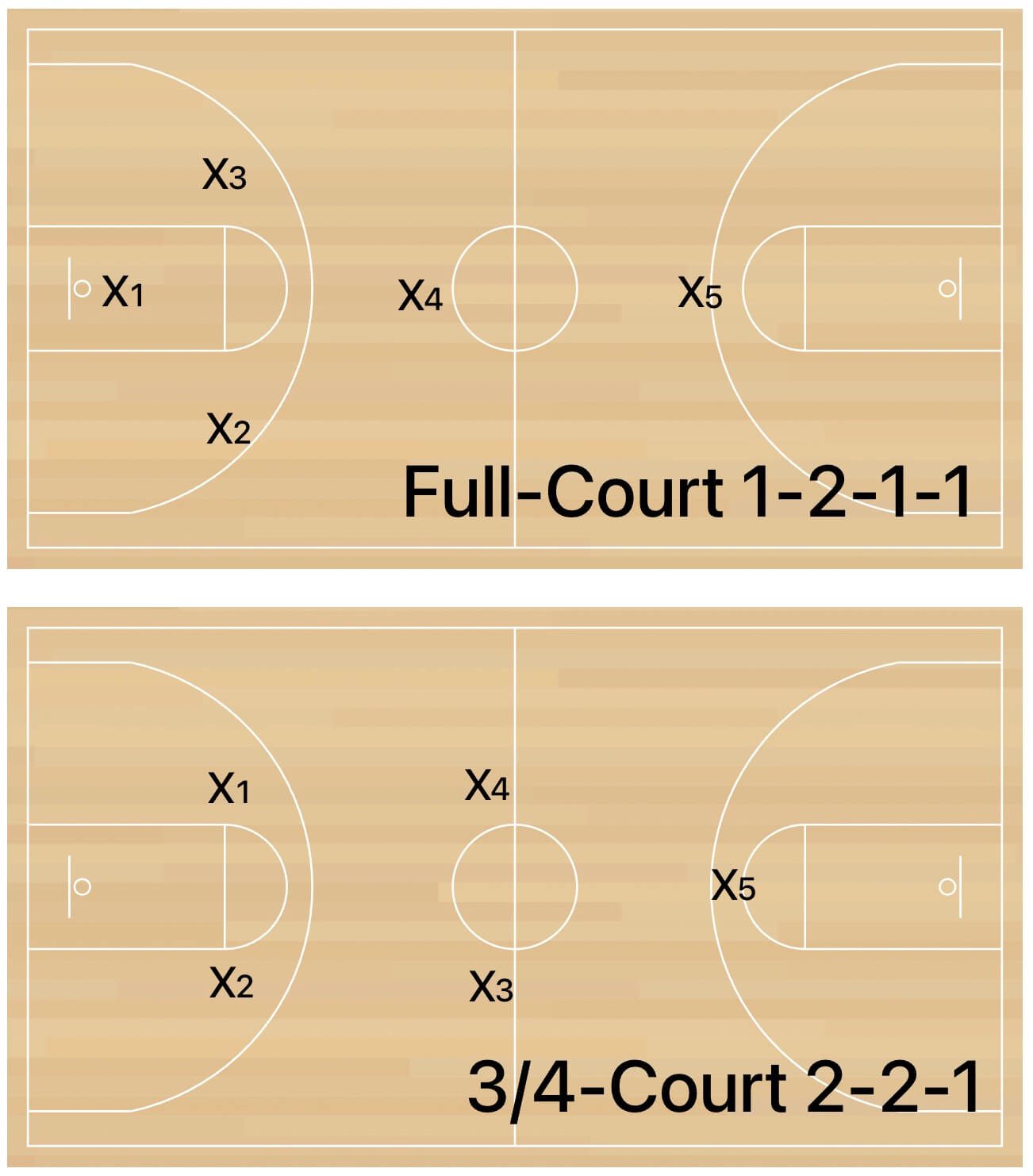
1. Full-Court Press ("80") – The defense pressures all the way to the opponent's baseline, usually with a defender guarding the inbound passer. The 1-2-1-1 diamond press is a classic example.
2. 3/4-Court Press ("60") – The defense allows the inbound pass, then picks up the ball around the free-throw line extended. The 2-2-1 press is traditionally a 3/4-court press, even though most coaches talk about it alongside the full-court presses.
3. Half-Court Press ("40") – The defense waits until the ball approaches the half-way line, then springs a trap as the ball-handler crosses. Less of a gamble, since all five defenders are already back.
The 8 Types of Full-Court Press
There are many different presses for a coach to pick from, and depending on your team's personnel, some will suit your team far better than others.
Here are the 8 most common:
1. Man-to-Man Press
Every defender guards a direct opponent for the entire length of the court, using the same on-ball, deny, and help principles as regular man-to-man defense. Best for teams that want pressure without complicated rotations. The weakness: a composed ball-handler can dribble through it if your on-ball defenders can't contain.
2. Run and Jump Press
A man-to-man press with rules that encourage aggressive jump-switching and surprise traps as the ball-handler attacks. The run and jump defense is best for quick, athletic teams that thrive on chaos. The weakness: every gamble that doesn't come off leaves a teammate scrambling to rotate.
3. 2-2-1 Press
Two players across the free-throw line, two near the half-way line, and one safety deep. The 2-2-1 press is best for teams that want to control tempo and contain the basketball. The weakness: it rarely produces steals against patient teams.
4. 1-2-1-1 Press (Diamond)
One player pressuring the inbound pass, two across the free-throw line, one at half-way, and one safety. The 1-2-1-1 diamond press is best for aggressive teams hunting turnovers immediately off the inbound. The weakness: a completed pass over the first trap often creates a numbers advantage for the offense.
5. 1-3-1 Press
One defender on the ball, three across the middle of the floor, and a safety deep. The 1-3-1 press is best for long, athletic teams that want to funnel the ball sideline and trap near half-court. The weakness: quick ball reversal can beat the rotations before they're set.
6. 1-2-2 Press
One player at the free-throw line, two just before half-way, and two deep. The 1-2-2 press is best for teams that want a conservative press that protects the basket first. The weakness: less immediate pressure on the inbound pass than the aggressive presses.
7. 2-1-2 Press
Two players on the front line, one in the middle, and two deep. The 2-1-2 press is best for keeping the ball out of the middle of the floor while still creating trapping opportunities. The weakness: the middle defender carries a huge workload and must be one of your smartest players.
8. 3-1-1 Press
Three players across the free-throw line, one just before half-way, and a safety deep. Best for flooding the inbound area and forcing a lob over the top. The weakness: once the first line is beaten, there's very little help behind it.

How to Run a Full-Court Press: 8 Key Strategies
No matter which press you choose from the list above, the same principles decide whether it works or falls apart.
These are the 8 keys I'd drill with any pressing team:
1. Force a Difficult Pass, Not a Steal – The goal of a trap is NOT to steal the ball. The top priority is forcing a difficult pass. A lob over the top, a rushed pass under pressure, a slow bounce pass out of the trap. If a clean steal is there, take it... but that's the bonus, not the plan.
2. Never Foul the Trap – Nothing kills a press faster than reaching in and sending the offense to the line. Trapping defenders keep their hands high, take up space, and let the pass happen.
3. Keep the Ball Out of the Middle – Every press dies when the ball gets to the middle of the floor, because the offense can attack in any direction. We need to force the dribbler towards the sideline, where the boundary line acts as an extra defender. As Huggins puts it, the press should "force you into an area that puts you in a bad position."
4. Rotate Behind the Trap – This is where the steals actually come from. While two defenders trap, the off-ball defenders read the passer's eyes and step into the passing lanes to intercept the difficult pass the trap just forced.
5. Always Keep a Safety Back – One player protects the basket at all times. Their job is to take away the long pass over the top and turn any breakaway into a contested finish instead of an open layup.
6. Sprint Back the Moment the Press Is Broken – The desire to sprint back on defense after the press has been broken is the most important part of running a full-court press. No press forces a turnover every trip — even great ones get beaten regularly — so every player must turn and SPRINT the instant the ball passes their line.
7. Communicate on Every Possession – A press can look different every time down the floor depending on where the inbound pass goes. Constant talk keeps the rotations connected and adds to the chaos the offense is experiencing.
8. Chart Your Press and Adjust – Bob Huggins' "Press Virginia" teams at West Virginia built their identity on full-court pressure, and a staff member charted every game, tracking which sectors of the floor opponents inbounded the ball to and where it went next, so Huggins could tweak the trap points mid-game.
9 Reasons to Run a Full-Court Press
Most coaches judge a press purely on turnovers.
And that's selling it short... a press doesn't need to result in a steal to be effective.
Here are 9 reasons to press, and the situations where each one hits hardest:
1. To Create Turnovers – The obvious one. Every steal your press generates is an extra possession, and usually an easy scoring opportunity at the end of it. This is most effective against teams without a composed guard, because dribbling and passing under pressure are the two skills that beat a press.
2. To Dictate the Tempo of the Game – This is the benefit most often overlooked, yet it might be the most important. A press forces the opponent to play at YOUR speed — deadliest against teams that love to slow the game down and pound the ball inside to a dominant post player. That discomfort often persists even after you drop the press later in the game.
3. To Force Rushed Shots – Against undisciplined teams, pressure encourages players to speed up and take more risks with their shot selection. Bad shots for them are rebounds and run-outs for you.
4. To Waste the Shot Clock – If you play in a league with a shot clock, a disciplined press makes the offense burn precious seconds just getting the ball across half-way. The longer it takes them to get into their offense, the worse the shot they end up with.
5. To Fire Up Your Own Team – For whatever reason, players of all ages LOVE playing pressure defense. Some games your team comes out flat and a high-intensity press is a great way to snap them out of a sluggish start.
6. To Stop an Opposition Run – A quick 6-8 point run can skyrocket the opposition's confidence. Changing the defense and the tempo with a press is one of the best ways to break their rhythm and take back control (and it beats burning a timeout every time).
7. To Wear the Opponent Out Mentally – Facing a press is exhausting. If their guards turn around and see a press waiting every single time they inbound the ball, there will come a point in the game when the mental errors start.
8. To Wear the Opponent Out Physically – Pressing removes the 5-8 second breather teams normally get while walking the ball up the floor. Against a team with a limited bench, that adds up fast — you rotate fresh players in while their key players never leave the floor.
9. To Take Their Star Player Out of the Game – Against a great point guard, a press forces them to give the ball up early, and denies them the rest they'd normally get walking the ball up after made baskets. Deny the easy return pass and a different player has to organise the offense... and that's a win before the possession even starts.
The Negatives of Running a Full-Court Press
Pressing isn't free.
Before committing to a press, make sure you've weighed these three costs:
1. You Will Give Up Easy Baskets – Every press is a gamble, especially the trapping ones. When the offense breaks through, they'll often have a 2-on-1 or an open layup waiting, and you have to be comfortable with that trade-off.
2. Fouls Add Up Fast – Aggressive defenders reaching in traps and bumping ball-handlers in the open floor pick up cheap fouls. Foul trouble hurts pressing teams twice, because the press also demands a deep rotation to keep legs fresh.
3. It Eats Practice Time – If you follow BFC, you'll know we recommend the 50/25/25 practice structure: 50% skill development, 25% strategy, 25% small-sided games. A press has to fit inside that strategy slice alongside your half-court offense and defense. Something has to give, and it shouldn't be skill development.
Should Youth Basketball Teams Run a Full-Court Press?
In my opinion, no.
(and I know this position makes some coaches angry)
Here's the truth about why full-court presses are so effective in youth basketball:
The players are physically weak.
Your team of 10-year-olds dominating with their press isn't proof of brilliant tactics... it works for two mechanical reasons:
1. Young Players Can't Pass Over the Press – They don't have the strength to throw an accurate full-court pass that leads to a layup, so the defense can flood the front court without any fear of being punished behind them.
2. Young Players Can't Pass Through the Press – Beating a zone press requires low, hard, quick passes between multiple defenders. Young players have to wind up to generate that power, which telegraphs every pass... so the flooded defense picks off lob after lob.
The result is a game played at 100 miles per hour consisting entirely of steals and fast-break layups, and very little development happens in a game like that.
One important exception:
A full-court MAN-TO-MAN press is perfectly fine for youth teams. It's the trapping zone presses that exploit these weaknesses.
For more on this, read zone defense in youth basketball.
How to Choose the Right Full-Court Press
With 8 presses to pick from, here are the four questions that should drive the decision:
1. Do You Want to Play Fast or Slow? – Evaluate the speed at which your team plays its best basketball. Teams that want to fly get steals from an aggressive 1-2-1-1 and attack immediately. Teams that prefer control use a 2-2-1 to contain, force a turnover, and then run their half-court offense.
2. How Much Risk Can You Stomach? – Every press sits somewhere on a spectrum from aggressive to conservative. An aggressive press like the 1-2-1-1 gambles for steals and accepts it will give up some layups. A conservative press like the 1-2-2 makes the offense work without risking much behind it.
3. Does It Fit Your Personnel? – If you have a rim protector who can handle a 2-on-1, you can afford an aggressive press knowing your safety cleans up mistakes. If you don't, choose a press that protects the basket first.
4. Does It Fit YOUR Personality? – This is the question coaches skip, and it burns them. If defensive breakdowns and easy baskets eat at you on the sideline, an aggressive trapping press was never going to be a good fit... no matter how well it worked for the team you saw run it. Your system has to align with your coaching philosophy, or you'll never fully commit to it — and your players will see that.
One more recommendation:
Teach ONE press and adjust the pressure within it, rather than teaching multiple presses. Turn the heat up against weaker opponents, drop into containment against stronger ones.
You get the flexibility of two defenses for the practice cost of one.

Who Invented the Full-Court Press?
The full-court press is most often credited to John McLendon, the Hall of Fame coach who pioneered the full-court game at North Carolina College in the 1940s — and later proved it at the highest level, winning three straight NAIA national championships at Tennessee A&I from 1957 to 1959.
Because McLendon coached in the segregated Black college leagues, his innovations went largely uncredited for years. Gene Johnson, who coached at Wichita in the late 1920s and early 1930s, is also credited with an early version of the press.
The press went mainstream in 1964, when UCLA assistant Jerry Norman convinced John Wooden to use a full-court zone press to compensate for an undersized roster. The Bruins won their first national championship with it.
Since then, it's produced some of the sport's most famous defensive identities — from Nolan Richardson's "40 Minutes of Hell" at Arkansas to Shaka Smart's "Havoc" press at VCU.
Full-Court Press FAQ
What does "full-court press" mean?
In basketball, a full-court press means applying defensive pressure across the entire length of the court, starting as soon as the opponent inbounds the ball.
How do you break a full-court press?
Spacing, composure, and quick passes. The ball moves faster than any defender can run, so a press break built on short, sharp passing will beat pressure far more reliably than one player trying to dribble through it. I've written a complete guide on this, including the formation I recommend and the rules that make it work: How to Break a Full-Court Press (1-4 Press Break).
Should you stop pressing when you have a big lead?
At the high school level, my line is 25 points. After that, pull back into half-court man-to-man and work on your on-ball defense and rotations. When I asked this question on Twitter, the general consensus was 20, but Coach MacDonnell made a point that swayed me higher: the bench players deserve the chance to run the same system the starters do, rather than sitting back and playing passive because the starters did their job.
Should youth basketball teams run a full-court press?
Not a zone press. Youth zone presses work by exploiting the fact that young players lack the strength to pass over or through them, and the resulting steal-and-layup track meet develops nobody. A fundamentals-focused man-to-man press is fine. See the youth section above for the full reasoning.
What is the best full-court press in basketball?
There isn't one. The 1-2-1-1 creates the most turnovers but gives up the most layups, the 2-2-1 and 1-2-2 contain without gambling, and the man-to-man press is the simplest to teach. The best press is the one that fits your personnel, your risk tolerance, and your personality as a coach... so work through the four questions above.
Conclusion
A full-court press is one of the most effective ways to force turnovers, control the tempo of the game, and take an opponent out of their comfort zone.
But remember the key:
When they want to slow down and control the ball, speed them up.
When they want to play fast and score quickly, slow them down.
Pick the press that fits your personnel and your personality, drill the 8 keys until they're habits, and commit to it. And if you're coaching youth basketball... stick to man-to-man.