
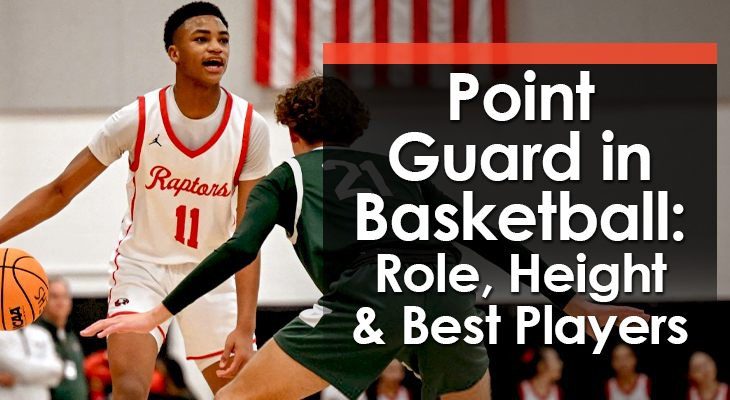
The point guard (also called the "one") is one of the five positions in basketball.
Point guards are usually the smallest and quickest players on the court, and they're responsible for bringing the ball up the floor, running the offense, controlling the tempo, and creating scoring opportunities for their teammates.
Traditionally, that meant a pass-first player whose own scoring came last.
The modern game has changed that... but we'll get to the scoring point guard later in this guide.
What Is a Point Guard in Basketball?
A point guard is one of the five basketball positions, and it's the most specialized role on the floor.
Positions are numbered 1 through 5: the point guard is the 1, the shooting guard is the 2, the small forward is the 3, the power forward is the 4, and the center is the 5.
That's why you'll hear a point guard called "the 1" or "the point."
While the other four positions are focused mainly on scoring, the point guard's first job is different:
Get the ball to the right player, in the right spot, at the right time.
That means the point guard touches the ball more than anyone else on the team. They decide when to push the pace and when to slow things down. They call the plays. And they're responsible for making sure all five players are organized on every possession.
It's the closest thing basketball has to a quarterback.
The 8 Best Point Guards of All Time
You can't understand the position without studying the players who defined it. Here are eight of the greatest to ever run the point:
1. Magic Johnson – At 6'9", Magic broke every rule about what a point guard should look like and still played the position better than anyone. Five championships, three MVPs, and the most spectacular passing the game has ever seen.
2. Stephen Curry – The greatest shooter of all time turned the point guard position into the most dangerous scoring role in basketball. Four championships, two MVPs (including the only unanimous MVP in NBA history), and he changed how every level of the game is played.
3. Oscar Robertson – The "Big O" averaged a triple-double across an entire season decades before anyone thought it was possible. The most complete all-around guard of his era.
4. John Stockton – The NBA's all-time leader in both assists and steals, and it's not close. Stockton ran the pick-and-roll with Karl Malone for 18 seasons and never missed more than a handful of games.
5. Isiah Thomas – The heart of the "Bad Boy" Pistons and the best small guard of his generation. Two championships and a Finals MVP, won in the toughest era of physical defense the league has known.
6. Steve Nash – Back-to-back MVPs running the "Seven Seconds or Less" Suns. Nash proved that elite shooting and passing from the point guard spot could power an entire offensive system.
7. Chris Paul – The "Point God." One of the smartest players to ever run a team, and among the all-time leaders in both assists and steals. The model for how a true floor general controls a game.
8. Sue Bird – The greatest point guard in WNBA history. Four championships across three different decades, the league's all-time assists leader, and five Olympic gold medals.
What Does a Point Guard Do?
The point guard has more responsibilities than any other position on the court.
Here's what the role looks like on both ends of the floor:
On Offense:
1. Bring the Ball Up the Court – The point guard advances the ball against defensive pressure on every possession. This is why elite ball-handling is non-negotiable — losing the ball in the backcourt gives the opposition easy points.
2. Run the Offense – The point guard calls the plays and gets teammates into the correct positions before the action starts. If the offense looks disorganized, the point guard is usually the reason... and if it hums, same answer.
3. Control the Tempo – Push the ball on a fast break when the numbers are there. Slow it down and run a set when they're not. The point guard makes that read on every single possession.
4. Create for Teammates – Whether it's a pick and roll, a drive-and-kick, or an entry pass to the post, the point guard's job is to create easy shots for others. A good point guard racks up assists without forcing anything.
5. Score When the Defense Allows It – Modern point guards are scoring threats. When the defense goes under a screen or loses track of the ball-handler, the point guard has to make them pay.
On Defense:
6. Pressure the Opposing Ball-Handler – The point guard usually picks up the other team's primary ball-handler and makes every trip up the floor uncomfortable.
7. Fight Over Screens – Opponents will run their own pick and roll at your point guard all game. Getting over the top of screens (or making the right choice to go under) is a huge part of the job.
8. Communicate and Get Back – The point guard is often the first player back in transition defense and the one directing traffic when the defense scrambles.
5 Traits of a Great Point Guard
Skills can be trained. These five traits are what separate a real floor general from a player who just happens to dribble the ball up the court:
1. Leadership – The point guard is the extension of the coach on the floor. They direct teammates, pump the team up, and take responsibility when things go wrong. A quiet point guard is a problem.
2. Team-First Mentality – The moment a point guard cares more about their own stats than the team's win-loss record, you're in trouble. Their only goal on each possession should be creating the best shot available — regardless of who takes it.
3. Elite Ball Control – The point guard has a dozen things on their mind in the first 8 seconds of a possession. None of those can be "am I about to lose this dribble?" Ball-handling must be automatic. That's built through thousands of reps of dribbling drills.
4. High Basketball IQ – Reading the defense, knowing which play beats which coverage, tracking the shot clock, the score, and the foul count... a great point guard processes all of it in real time. Basketball IQ matters more at this position than any other.
5. Knowing Teammates' Strengths and Weaknesses – A great point guard knows who's hot, who has a mismatch, and who should NOT be taking the next shot. Then they get the ball where it needs to go.
Types of Point Guards
Not every point guard plays the position the same way. Most fall into one of three types:
1. The Pass-First Floor General – The traditional point guard. Their first instinct is always to create for others, and their scoring comes as a last option. Think John Stockton or prime Rajon Rondo.
2. The Scoring Point Guard – The modern evolution of the position. These guards are their team's best scoring threat AND its primary ball-handler. Stephen Curry turned this into the most valuable player type in basketball.
3. The Combo Guard – A player who blends both guard spots — comfortable running the offense or playing off the ball. There's more on the combo guard role in our shooting guard breakdown.
How the position has evolved:
For most of basketball history, point guards were pure facilitators. Shooting was optional (plenty of great ones couldn't shoot at all).
The modern game flipped that.
Today's point guards are expected to be three-level scorers who bend the defense with shooting range, and the rise of positionless basketball means bigger players now handle point guard duties too. The job description hasn't changed - organize the team, create good shots - but the toolkit required has grown.
How Tall Are Point Guards?
The point guard is usually the shortest player on the court at every level of basketball.
Typical height ranges:
- NBA: 6'0" – 6'4"
- WNBA: 5'6" – 5'9"
- Men's college: 5'10" – 6'2"
- High school: 5'7" – 6'0"
But height matters less at point guard than at any other position.
Quickness, ball-handling, and decision-making are what win the role. Isiah Thomas dominated at 6'1". Magic Johnson dominated at 6'9". The position has room for both... which is exactly what makes it unique.
How to Play Point Guard (8 Tips)
If you're a point guard, here's where to focus:
1. Make Ball-Handling Automatic – You can't read the defense if you're thinking about your dribble. Put in daily work until handling pressure feels boring.
2. Keep Your Head Up – Every great point guard dribbles with their eyes up the floor. You can't pass to a player you never saw.
3. Master the Pick and Roll – It's the most common action in basketball, and the point guard runs it more than anyone. Learn every read: the pocket pass, the lob, the pull-up, the reject.
4. Value the Basketball – Your assist-to-turnover ratio tells the truth about your decision-making. Two assists for every turnover is a solid target - elite floor generals do even better.
5. Learn Every Position's Job – You can't organize four teammates if you don't know where they're supposed to be. Study the whole playbook, not just your part of it.
6. Talk. Constantly. – Call the plays loudly. Point players to their spots. Communicate on defense. A silent point guard isn't running the team.
7. Change Pace – The best point guards aren't always the fastest, but they're the hardest to time. Slow to fast beats fast all the time.
8. Be the Hardest Worker in the Gym – Leadership isn't given with the position. It's earned in guard workouts before anyone else shows up.
Point Guard FAQ
What's the difference between a point guard and a shooting guard?
Ball responsibility. The point guard is the primary ball handler and decision-maker who brings the ball up and runs the offense. The shooting guard plays off the ball as the team's main perimeter scorer, earning shots through movement rather than the dribble — though the modern game blurs the two roles more than ever.
Is point guard the hardest position in basketball?
Many coaches think so. No other position has to handle the ball under constant pressure, know every player's role on every play, and make split-second decisions that affect all five teammates. Centers have a harder physical job — point guards have the hardest mental one.
Who is the best point guard in the NBA right now?
It changes year to year, but Shai Gilgeous-Alexander and Luka Dončić lead most current discussions, with Stephen Curry still in the conversation deep into his career.
Why is a point guard called "the 1"?
Basketball positions are numbered 1 through 5 for play-calling, and the point guard is the 1. When a coach draws up a play, "1" always refers to the point guard's role in it.
Do point guards need to be great scorers?
No — but it helps more than it used to. Players like Rajon Rondo proved you can run a team at the highest level without a reliable jump shot. But in the modern game, a point guard who can't score lets the defense sag off and clog everyone else's space.
Conclusion
The point guard is the engine of a basketball team.
They handle the ball more than anyone, make more decisions than anyone, and carry more responsibility than anyone — often while being the smallest player on the court.
Great teams almost always have a great point guard in basketball. If you're building a team, start there. If you're a player who loves making others better... you've found your position.